BaaS Providers Compared: What to Look for in a Platform Partner
Key Takeaways
- The global BaaS market reached $637 billion in 2024 and is projected to exceed $1.49 trillion by 2030 at a 15.7% CAGR (Grand View Research, 2024) - making BaaS provider selection one of the highest-stakes infrastructure decisions a fintech will make.
- Switching BaaS providers mid-operation typically costs six to seven figures in direct engineering and compliance expenses, not counting revenue disruption during migration. The 2024 Synapse Financial collapse demonstrated how platform failure can freeze $160-200 million in customer funds.
- The best BaaS providers differentiate on three axes: jurisdictional breadth (single-market vs. multi-region), compliance infrastructure depth (bolt-on vs. embedded), and API maturity (documentation quality, sandbox access, versioning stability).
- Regulatory tightening across the U.S. (OCC), UK (FCA), Singapore (MAS), and Australia (APRA) has made sponsor bank governance a primary evaluation criterion - not a secondary compliance checkbox.
- UK fintechs face specific considerations around FCA authorization requirements, e-money safeguarding rules, and post-Brexit cross-border passporting gaps that narrow the field of viable BaaS providers.
Choosing between BaaS providers is an infrastructure decision that compounds over years. The platform you select determines which markets you can enter, how fast you can launch products, and how much compliance risk you absorb directly. Yet most fintechs evaluate BaaS providers the same way they evaluate SaaS tools - feature checklists and pricing comparisons - when the actual differentiators are regulatory architecture, sponsor bank stability, and contract terms that only surface during due diligence. This guide provides the evaluation framework that separates the best BaaS providers from the rest, with specific guidance for UK fintechs navigating the FCA’s evolving regulatory expectations.
Contents
- Why BaaS Provider Selection Matters
- The BaaS Provider Landscape in 2026
- How to Compare BaaS Providers: The Evaluation Framework
- BaaS Provider Evaluation Matrix
- What UK Fintechs Should Prioritize
- Common Mistakes When Choosing a BaaS Provider
- Frequently Asked Questions
Why BaaS Provider Selection Matters
Banking as a Service sits between your product and the regulated financial system. It is not a plug-and-play service that can be swapped out like a payment gateway. Your BaaS provider determines your regulatory posture, your product velocity, and your operational resilience.
Three factors make this decision particularly consequential.
The cost of switching is high. Migrating between BaaS providers involves re-integrating APIs, re-onboarding customers through new KYC processes, re-certifying with card schemes, and notifying regulators in every jurisdiction you serve. The 2024 Synapse Financial collapse, which froze $160-200 million in customer funds, demonstrated how BaaS platform failure cascades directly to end customers. Even planned migrations involve 3-6 months of engineering disruption. The indirect costs - lost product velocity, customer churn during transition, and compliance gaps during migration - are harder to quantify but often larger.
Regulatory risk is asymmetric. If your BaaS provider’s sponsor bank receives a consent order or exits fintech partnerships, your products stop working. This is not a hypothetical scenario. Multiple U.S. BaaS arrangements were disrupted in 2023-2024 when regulators issued enforcement actions against sponsor banks. The 2024 Synapse Financial collapse froze $160-200 million in customer funds, illustrating how sponsor bank instability cascades directly to end customers.
Product scope constrains growth. A BaaS provider that covers payments but not card issuance or customer management forces you to integrate additional vendors for each new product line. Every additional vendor introduces a new API surface, a new compliance relationship, and a new failure domain. The compounding integration cost shapes your product roadmap for years.
The BaaS Provider Landscape in 2026
Grand View Research valued the global BaaS market at $637 billion in 2024 and projects it to reach $1.49 trillion by 2030, growing at a CAGR of 15.7%. This growth has attracted a wide range of providers, from purpose-built BaaS platforms to banks offering direct API access to legacy core banking vendors adding BaaS layers.
The landscape has consolidated around three provider models.
Pure-play BaaS platforms operate as technology middleware between sponsor banks and fintechs. They own the API layer, compliance tooling, and developer experience. They do not hold banking licenses themselves but maintain relationships with one or more licensed sponsors. The strength of this model lies in developer experience and speed of integration. The vulnerability is sponsor bank dependency.
Bank-led BaaS programs are offered by licensed banks that have built their own API layers and fintech partnership infrastructure. These programs eliminate the sponsor bank dependency risk (the bank is the sponsor) but often deliver weaker developer experiences and slower product iteration. Bank-led programs tend to have narrower product scope, reflecting the issuing bank’s own capabilities.
Infrastructure aggregators combine BaaS capabilities with adjacent services - payments processing, card issuance, compliance tooling, wealth management infrastructure - into a single platform. This model reduces the number of vendor relationships a fintech must manage but requires the aggregator to maintain depth across multiple product domains.
For fintechs evaluating the field, the model matters less than the execution against the specific criteria that follow.
How to Compare BaaS Providers: The Evaluation Framework
The evaluation dimensions below are ordered by impact. Licensing and compliance are foundational - if a provider fails here, nothing else matters. API quality and product breadth determine your development velocity. Commercial terms determine your economics.
1. Licensing and Regulatory Coverage
The single most important criterion. A BaaS provider’s regulatory coverage determines where you can operate and under what conditions.
What to evaluate:
- How many jurisdictions does the provider cover? Through what licensing arrangements?
- Does the provider hold licenses directly, or does it operate through sponsor bank partnerships?
- In each jurisdiction, what products are covered by the existing licensing structure?
- How does the provider handle cross-border compliance for customers operating across multiple markets?
Red flags:
- Single-jurisdiction coverage with vague “expansion plans” for additional markets
- Inability to name the sponsor bank or confirm the sponsor’s regulatory standing
- No documented process for regulatory change management
2. Sponsor Bank Governance
Regulators in the U.S. (OCC), UK (FCA), Singapore (MAS), and Australia (APRA) have all tightened oversight of bank-fintech partnerships in 2024-2026. The quality of a BaaS provider’s sponsor bank relationships is now a primary evaluation criterion, not a compliance afterthought.
What to evaluate:
- How many sponsor bank relationships does the provider maintain? Is there concentration risk?
- What is the sponsor bank’s regulatory history? Any consent orders, enforcement actions, or public supervisory concerns?
- What does the provider’s sponsor bank due diligence process look like?
- How are responsibilities between the sponsor bank, BaaS platform, and fintech documented and enforced?
Red flags:
- A single sponsor bank with no contingency arrangement
- Unwillingness to disclose the sponsor bank’s identity during commercial discussions
- No documented responsibility matrix (RACI) for compliance obligations
3. API Architecture and Developer Experience
API quality directly determines your time to market and ongoing engineering cost.
What to evaluate:
- Is sandbox access available before contract signing?
- What is the API documentation quality? Is it auto-generated from code, or manually curated with examples?
- How does the provider handle API versioning? What is the deprecation policy for breaking changes?
- What are the published uptime SLAs? What penalties apply for downtime?
Red flags:
- No sandbox environment or sandbox that does not reflect production behavior
- API documentation behind an NDA with no public developer portal
- History of unannounced breaking changes
4. Compliance Infrastructure
The compliance stack is where BaaS providers differ most and where shortcuts create the most risk.
What to evaluate:
- Does the provider offer embedded KYC, AML, and transaction monitoring, or do these require third-party integrations?
- How does the provider handle sanctions screening? Is it real-time or batch?
- What regulatory reporting does the platform generate automatically?
- Can the compliance infrastructure handle multiple jurisdictional requirements simultaneously?
Red flags:
- Compliance described as “partner integrations” rather than built-in capabilities
- No real-time transaction monitoring
- KYC limited to basic identity verification without ongoing monitoring
Building on BaaS infrastructure? Explore Aerapass global payments for multi-jurisdiction coverage, real-time settlement, and embedded compliance through a single API integration.
5. Payment Network Connectivity
The depth of a provider’s payment network connections determines which payment methods and corridors you can offer.
What to evaluate:
- Which payment schemes and networks does the provider connect to directly?
- What settlement timeframes apply for each payment type?
- Does the provider support local payment rails in target markets, or only international schemes?
- What is the provider’s approach to payment reconciliation and exception handling?
Red flags:
- Reliance on a single payment processor with no direct network relationships
- No support for local payment rails in key target markets
- Manual reconciliation processes
6. Card Issuance Capabilities
If your product roadmap includes branded cards, evaluate card capabilities early. Adding card infrastructure later through a separate provider creates significant integration complexity.
What to evaluate:
- Does the provider support prepaid, debit, and virtual card issuance?
- What card scheme relationships does the provider maintain (Visa, Mastercard, or both)?
- Does the provider offer BIN sponsorship, or does the fintech need to arrange this separately?
- What card management APIs are available (provisioning, limits, freezing, replacement)?
Red flags:
- Card issuance described as “on the roadmap” rather than in production
- BIN sponsorship not included - fintech must arrange directly with the card scheme
- No virtual card capability
7. Ledger and Reconciliation Infrastructure
The ledger is the foundation of every financial product. BaaS providers that outsource or simplify their ledger capabilities create operational risk for fintechs.
What to evaluate:
- Does the provider maintain a real-time, double-entry ledger?
- How does the provider handle multi-currency balances and conversions?
- What reconciliation tooling is available? Is it automated or manual?
- What audit trail does the ledger maintain, and is it sufficient for regulatory examination?
Red flags:
- Batch-processed ledger updates rather than real-time
- No multi-currency support or limited currency coverage
- Manual reconciliation as the primary method
8. Time to Market and Integration Support
Launch speed is often the stated reason for choosing BaaS. Measure it against reality.
What to evaluate:
- What is the provider’s average time from contract signing to first production transaction?
- What integration support is available (dedicated team, documentation only, or tiered)?
- Does the provider offer pre-built UI components, or is all frontend work on the fintech?
- What is the typical timeline for adding new products or jurisdictions post-launch?
Red flags:
- Launch time estimates that exclude compliance onboarding and regulatory approval
- No dedicated integration support - documentation-only onboarding
- No reference customers willing to share their integration experience
9. Pricing Transparency
BaaS pricing is notoriously opaque. Providers that resist total cost of ownership analysis are usually expensive.
What to evaluate:
- Does the provider publish a rate card, or is pricing entirely custom?
- What are the pricing components? (platform fee, per-API-call, per-account, per-transaction, revenue share)
- What are the minimum commitments and volume thresholds?
- What costs are passed through vs. marked up (card scheme fees, payment network fees)?
Red flags:
- No published pricing and refusal to provide a total cost model during evaluation
- Revenue sharing as the primary pricing model (misaligns incentives as you scale)
- Hidden costs in pass-through fees
10. Data Portability and Exit Terms
The contract terms that matter most are the ones that apply when the relationship ends.
What to evaluate:
- Can you export customer data and transaction history in a standard format?
- What are the notice periods for termination by either party?
- Are there exclusivity clauses that prevent running a parallel integration during migration?
- Who owns the customer relationship data if the contract ends?
Red flags:
- Exclusivity clauses that prevent parallel BaaS integrations
- Customer data classified as the provider’s proprietary data
- Termination notice periods exceeding 12 months
BaaS Provider Evaluation Matrix
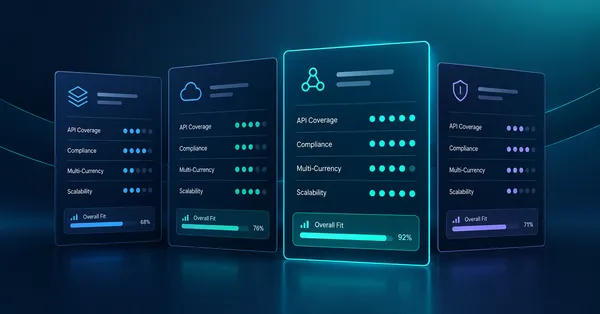
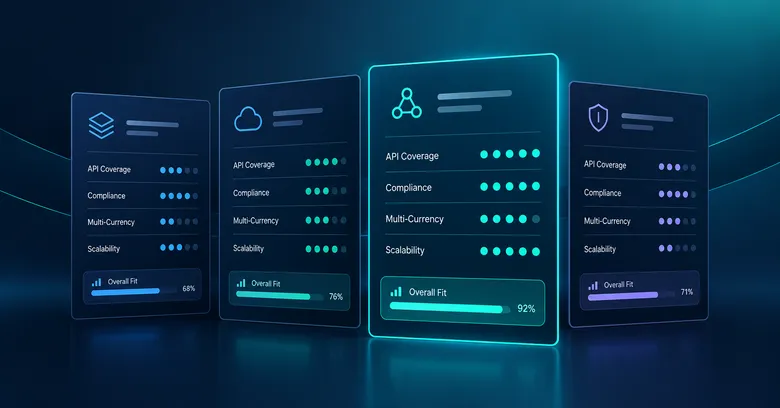
Use this matrix during your evaluation process. Score each provider on a 1-5 scale for each dimension and weight according to your specific priorities.
| Evaluation Dimension | What to Ask the Provider | Red Flags | Weight (Suggested) |
|---|---|---|---|
| Licensing coverage | ”Which jurisdictions are covered by existing licenses? Which require new arrangements?” | Single-market coverage with vague expansion plans | High |
| Sponsor bank governance | ”Who is the sponsor bank? What is their regulatory standing? Is there a contingency?” | Single sponsor, undisclosed identity, no RACI | High |
| API maturity | ”Can we access a sandbox today? What is your breaking change history?” | No sandbox, documentation behind NDA | High |
| Compliance stack | ”Is KYC/AML/monitoring embedded or third-party? Show us real-time screening." | "Partner integrations” for core compliance | High |
| Payment connectivity | ”Which payment rails do you connect to directly in our target markets?” | Single processor, no local rails | Medium |
| Card capabilities | ”Is card issuance in production? Is BIN sponsorship included?" | "On the roadmap,” BIN not included | Medium |
| Time to market | ”What was the average time to first production transaction for your last five customers?” | Estimates exclude compliance onboarding | Medium |
| Pricing transparency | ”Provide a total cost model for our projected volumes over 24 months.” | No published pricing, revenue-share-only model | Medium |
Sources: Evaluation criteria adapted from BIS Working Paper on Bank-Fintech Partnerships (2024), FCA Payment Services Supervision Report (2025), OCC Third-Party Risk Management Guidance (2024).
What UK Fintechs Should Prioritize
BaaS providers in the UK market face a specific set of regulatory and operational constraints that narrow the field. UK fintechs should evaluate providers against these additional criteria.
FCA authorization requirements. The FCA distinguishes between Authorized Electronic Money Institutions (EMIs), Authorized Payment Institutions (APIs), and Small Payment Institutions. The BaaS provider’s sponsor bank or licensing arrangement must align with the products the fintech intends to offer. Offering e-money services without proper EMI authorization is a criminal offense under the Electronic Money Regulations 2011.
E-money safeguarding. UK safeguarding rules require that customer funds held as e-money be segregated in designated safeguarding accounts with approved credit institutions. The BaaS provider’s approach to safeguarding - where funds are held, how they are segregated, and how the fintech can audit the arrangement - is a critical due diligence item. The FCA’s 2025 review of e-money firms found safeguarding deficiencies at multiple providers.
Post-Brexit cross-border limitations. UK-authorized firms can no longer passport services into the EU. BaaS providers that previously served both markets through a single UK license now require separate EU arrangements. For UK fintechs with European ambitions, verify that the BaaS provider has EU-based licensing (typically through Ireland, Lithuania, or the Netherlands) in addition to FCA authorization.
Consumer Duty obligations. The FCA’s Consumer Duty (effective July 2023) applies to all firms in the distribution chain, including BaaS platforms. UK fintechs should confirm that their BaaS provider has documented Consumer Duty compliance - covering price and value assessments, consumer understanding testing, and outcome monitoring. Providers that treat Consumer Duty as the fintech’s problem alone are misallocating regulatory risk.
Open Banking integration. The UK’s open banking ecosystem, built on the PSD2-derived framework, creates opportunities for BaaS providers that integrate with the Open Banking Implementation Entity (OBIE) standards. Evaluate whether the provider supports Variable Recurring Payments (VRPs) and Account Information Services (AIS), which are becoming table-stakes for UK-market fintech products.
Common Mistakes When Choosing a BaaS Provider
Evaluating on features rather than architecture. A feature checklist tells you what the platform does today. The architecture tells you what it can do in two years. Prioritize API design quality, ledger architecture, and multi-jurisdiction capability over the current feature count.
Ignoring sponsor bank risk. The sponsor bank is the regulatory foundation of the entire arrangement. If the sponsor bank receives a consent order, exits fintech partnerships, or becomes financially stressed, your products stop working. Due diligence on the sponsor bank should be at least as rigorous as due diligence on the BaaS platform itself.
Treating compliance as a separate procurement. BaaS providers with bolted-on compliance integrations create seams where data drops, latency increases, and regulatory gaps form. The compliance stack should be embedded in the platform, not layered on top through third-party partnerships.
Negotiating on price before architecture. The cheapest BaaS provider is the one you never have to switch away from. A lower monthly fee means nothing if the platform cannot support your second market, your card program, or your compliance requirements 18 months from now.
Skipping reference checks. Every BaaS provider will show you their best integration case study. Ask for the references they do not volunteer. Speak to customers who launched in the same jurisdiction, with the same product type, at a similar scale. Ask specifically about the post-launch experience - support quality, API stability, and how the provider handled production incidents.
Frequently Asked Questions
What is a BaaS provider?
A BaaS provider is a technology company that operates the infrastructure layer between licensed banks and fintech companies. The provider packages the sponsor bank’s regulated capabilities - accounts, payments, cards, lending - into APIs that fintechs integrate to build financial products. BaaS providers are distinct from sponsor banks (which hold the license and bear ultimate regulatory liability) and from fintechs (which own the customer relationship). For a detailed breakdown of the BaaS model and value chain, see our complete guide to Banking as a Service.
How many BaaS providers should a fintech evaluate?
Evaluate three to five providers for any serious selection process. Fewer than three limits your ability to benchmark pricing and capabilities. More than five creates evaluation fatigue without proportional information gain. Structure the evaluation in two rounds: an initial screening based on jurisdictional coverage, product scope, and pricing structure, followed by a deeper technical evaluation (sandbox testing, reference checks, contract review) for the two or three finalists.
Can a fintech switch BaaS providers after launching?
Yes, but the cost is substantial. A BaaS migration involves re-integrating APIs, re-onboarding existing customers through new KYC processes, re-certifying with card schemes, and coordinating with regulators in every jurisdiction served. Most migrations require 3-6 months of dedicated engineering effort. The key mitigation is selecting a provider with strong data portability terms and avoiding exclusivity clauses that prevent running parallel integrations during transition.
What questions should you ask a BaaS provider’s reference customers?
Ask about the post-launch experience, not the sales process. Specific questions: How long did the actual integration take versus the provider’s estimate? How does the provider handle production incidents and API downtime? How responsive is the provider to feature requests and product changes? Has the provider made any unannounced breaking changes? Would you select this provider again knowing what you know now?
How do BaaS providers in the UK differ from those in other markets?
UK BaaS providers operate under FCA regulation, which imposes specific requirements around e-money safeguarding, Consumer Duty obligations, and anti-money laundering controls. Post-Brexit, UK authorization no longer provides access to the EU market, so UK-focused providers must maintain separate EU licensing arrangements for cross-border coverage. The UK market also benefits from a mature open banking ecosystem that creates integration opportunities (Variable Recurring Payments, Account Information Services) not yet available in all markets.
Evaluating BaaS infrastructure? See how Aerapass financial infrastructure provides multi-jurisdiction coverage across Hong Kong, Singapore, Australia, and Canada through a single API integration.
Regulatory Disclosure: Aerapass financial services are provided through Aerapass, a Major Payment Institution licensed by the Monetary Authority of Singapore and regulated across four jurisdictions (Hong Kong, Singapore, Australia, and Canada). This article is for educational purposes only and does not constitute financial, legal, or regulatory advice. Regulatory requirements vary by jurisdiction and change over time. Companies evaluating BaaS infrastructure should consult qualified legal and compliance advisors in each market they intend to serve.
Sources cited: Grand View Research (BaaS Market Report, 2024), Bank for International Settlements (Bank-Fintech Partnership Working Paper, 2024), FCA (Payment Services Supervision Report, 2025), OCC (Third-Party Risk Management Guidance, 2024), MAS (Notice 644, Technology Risk Management), APRA (CPS 230, Operational Risk Management).
The content on this page is produced by Aerapass for general informational purposes only and does not constitute financial advice, investment advice, or any other form of professional advice. Aerapass is a technology platform provider serving financial institutions, wealth managers, and fintech companies. Before making any financial decision, you should consult with a qualified, licensed financial advisor who can take your individual objectives and circumstances into account.