Multi-Currency Payment Reconciliation: A Guide for Payment and Wealth Platforms

Key Takeaways
- Payment reconciliation is the process of matching every payment instruction, bank or wallet movement and ledger entry, and explaining every difference. Each extra currency and rail adds new places for those records to disagree.
- Most breaks in multi-currency payments come from five sources: FX conversion, fees deducted in transit, timing differences, missing or truncated references, and partial or bundled payments.
- Swift’s coexistence period for cross-border payment instructions ended on 22 November 2025, so structured ISO 20022 data is now the norm on that network (Swift, ISO 20022). Richer data makes automated matching far more reliable, but only if your systems keep it.
- The fastest gains come from carrying a unique reference from instruction to statement, recording the FX rate and fees on every leg, and reconciling every day.
A single-currency business can often reconcile its payments with a bank statement and a spreadsheet. Add a second currency, a third bank, a card acquirer and a stablecoin wallet, and the same job becomes a daily operational risk. Payments arrive net of fees, converted at a rate nobody recorded, under a reference that was cut short by an intermediary bank.
For payment platforms, wealth managers and fintechs that hold client money, reconciliation is not just an accounting chore. It is how you prove that every client balance is backed by real funds. This guide explains how multi-currency payment reconciliation works, where breaks come from, and what to automate first.
What Is Payment Reconciliation?
Payment reconciliation is the process of matching three sets of records and explaining any difference between them:
- The instruction. What you or your client asked to pay or expected to receive: amount, currency, beneficiary, reference, date.
- The movement. What actually happened on the rail: the bank statement line, the card settlement report or the on-chain transaction.
- The ledger. What your own system recorded against the client or account.
When all three agree, the payment is reconciled. When they don’t, you have a break that someone must investigate, explain and resolve.
In a single currency, most breaks are timing differences. In several currencies, the amount itself changes along the way. A EUR 10,000 invoice paid from a USD account may arrive as EUR 9,975 after an intermediary fee, booked at a rate set hours after the instruction was sent. Each of those differences has to be explained, not just matched.
Why Multi-Currency Reconciliation Is Harder
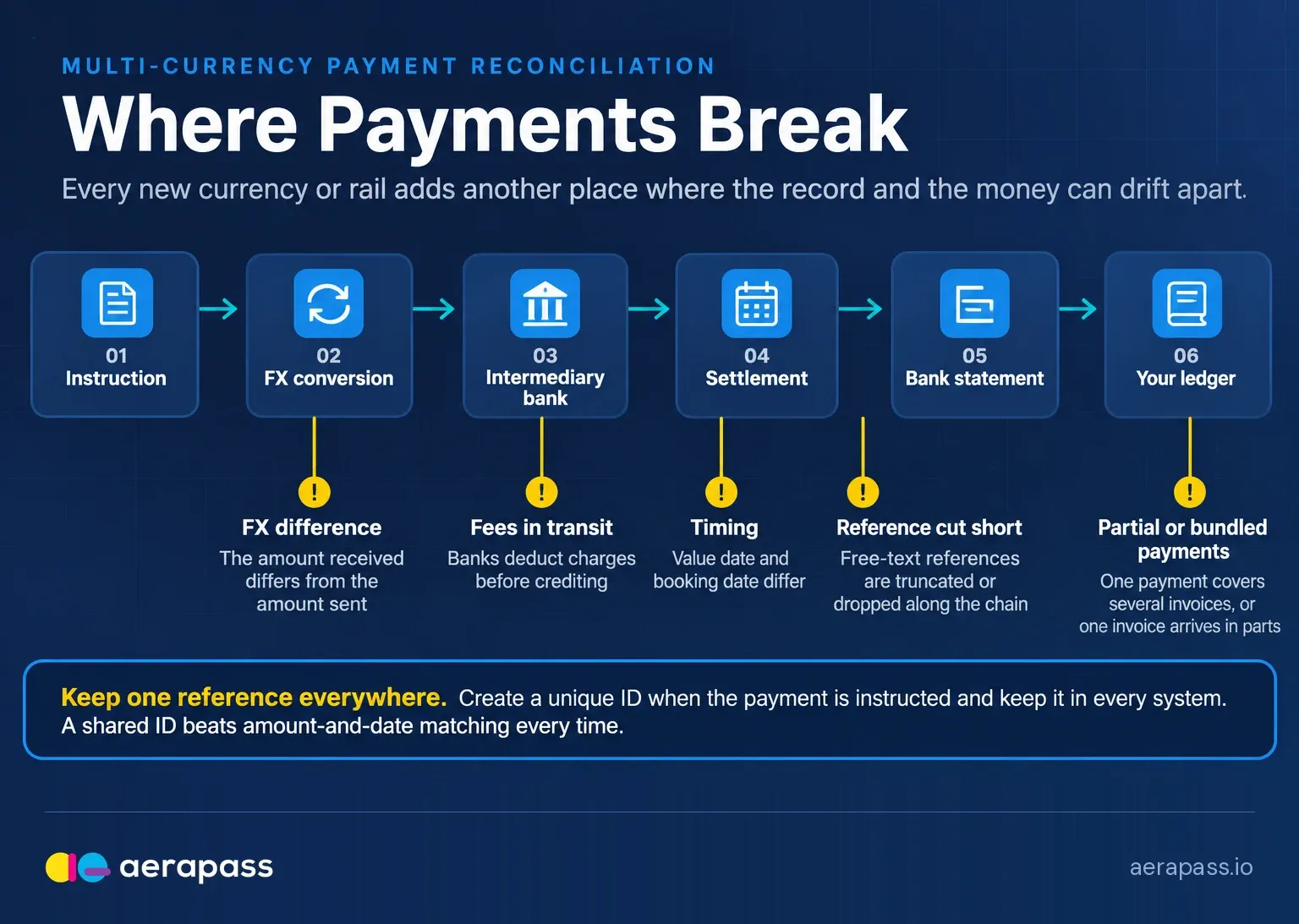
Every new currency or rail adds another record format, another cut-off time and another party that can change the amount. The table below shows where differences typically appear.
| Source of difference | What happens | What to record |
|---|---|---|
| FX conversion | The amount received differs from the amount sent because of the rate and when it was applied | The rate, the rate source and the time it was applied, on every conversion |
| Fees in transit | Intermediary or receiving banks deduct charges before crediting | Expected fees per corridor, and the charge option used (OUR, SHA or BEN) |
| Timing | The payment leaves one day and settles the next, or across a weekend or time zone | Value date and booking date, not just one “date” field |
| References | Free-text references are cut short or dropped by systems along the chain | A unique end-to-end ID created at instruction and kept in every system |
| Partial or bundled payments | One payment covers several invoices, or one invoice is paid in instalments | The allocation rule, so each part maps to the right obligation |
New rails add their own patterns. Card settlements usually arrive net of processing fees (interchange, scheme and acquirer charges), in batches, days after the transaction. Stablecoin transfers settle in minutes, at any hour. A payment can land at 2am on a Sunday, when your bank-side processes are closed. Our guide to multi-currency payment gateways covers how these rails differ at the point of acceptance.
The cost of getting this wrong is not only staff time. Swift notes that payment failures caused by incorrect or incomplete data, manual repair and limited straight-through processing all add operational effort, which ends up in pricing (Swift, G20 goals for cross-border payments).
Running payments in several currencies and rails? Aerapass gives you SWIFT, SEPA, ACH, local clearing networks and stablecoin rails in one platform, so you can choose the right method for each transaction. Explore Aerapass global payments
How ISO 20022 Changes Reconciliation
For years, cross-border bank payments travelled as MT messages with limited, free-text fields. References were often truncated, remittance details were squeezed into a few lines, and the receiving side had to guess what a payment was for.
ISO 20022 replaces those fields with structured data. A payment can carry a unique end-to-end reference, structured remittance information, and clearer details on the parties involved. Since the end of Swift’s cross-border coexistence period in November 2025, ISO 20022 is the standard for payment instructions on that network.
Two developments make this matter for reconciliation:
- Tracking. Swift reports that about 74% of payments on its network are now tracked end to end (Swift). Tracking data shows where a payment is, which bank charged what, and when it was credited.
- Richer statements. Banks can pass structured remittance and fee information through to statements and reports, so the movement record carries enough detail to match automatically.
The catch is that the benefit only reaches you if your own systems keep the data. If your ledger, ERP or client portal still stores a short free-text reference and a single “amount” field, the structured detail is lost at the last step. Check where your own systems cut the data down before you blame the bank.
What to Automate First
Not every break needs a sophisticated matching engine. Most platforms get the largest gains from five changes, in this order.
1. Create one reference and keep it everywhere. Generate a unique ID when the payment is instructed or the invoice is issued, and pass it through the payment, the bank or wallet record and your ledger. A shared ID beats amount-and-date matching every time.
2. Record FX on every leg. Store the rate, the rate source, the time it was applied and the amounts before and after conversion. Without these, an FX difference looks identical to a missing payment.
3. Expect fees, don’t discover them. Keep expected fees per corridor and rail, and reconcile against the expected net amount. A difference within a set tolerance can then be posted automatically, with only the exceptions sent for review.
4. Reconcile daily, by currency and account. Month-end reconciliation turns small breaks into large investigations. Daily matching by currency and by account keeps the exceptions list short and the cause easy to trace.
5. Use real-time payment status. Webhooks or API status updates tell you when a payment is sent, received, returned or rejected. Your ledger then updates as events happen, without waiting for a statement.
For platforms that hold client money, there is one more rule: reconcile client balances against the underlying bank and custody records, not just against your own ledger. That check is what shows that every client balance is backed by real funds.
Build or Buy Reconciliation?
Some firms build reconciliation in-house on top of bank files and an ERP. That can work for a few accounts in one or two currencies. It becomes harder as rails, banks and currencies multiply, because each new connection brings its own file format, cut-off times and failure modes.
The alternative is to run payments, FX and reconciliation on one platform. The instruction, the movement and the ledger entry are then created in the same system, with the same reference. For the cost and control trade-offs, see our fintech build vs buy guide. If you collect payments through several providers, our guide to payment orchestration explains how one layer can bring their reports into a single format.
Frequently Asked Questions
What is payment reconciliation?
Payment reconciliation is the process of matching payment instructions, the actual movements on bank, card or blockchain rails, and the entries in your own ledger, then explaining any difference. It confirms that every payment you expected was made or received, for the right amount, and recorded against the right client or account.
Why is multi-currency reconciliation harder than single-currency?
Because the amount changes along the way. FX conversion, fees deducted by intermediary banks, different value dates across time zones and shortened references all create differences between what was sent and what arrived. Each difference has to be explained, which needs the rate, fees and timing recorded on every leg of the payment.
What causes reconciliation breaks in cross-border payments?
The most common causes are FX rate differences, fees deducted in transit, timing differences between value and booking dates, missing or truncated references, and payments that cover several invoices or only part of one. Data quality is the root cause behind many of them, which is why structured ISO 20022 data helps.
How does ISO 20022 help payment reconciliation?
ISO 20022 replaces limited free-text fields with structured data, including unique end-to-end references and structured remittance information. Combined with end-to-end tracking, it lets receiving systems match payments automatically. The benefit depends on your own systems keeping that data rather than cutting it down to older formats.
How often should payments be reconciled?
Daily, by currency and by account, for any business handling material volumes or client money. Month-end reconciliation lets small breaks build into large investigations. Daily matching keeps exceptions few and recent, so the cause is still easy to find.
Can payment reconciliation be fully automated?
Most of it can. With a shared reference, recorded FX rates and expected fees, the large majority of payments match automatically and only exceptions need a person. Some cases, such as unexplained returns or payments with no reference, will always need review, so the aim is a short exceptions queue rather than zero human involvement.
Want payments, FX and reconciliation in one place? Aerapass APIs automate payment initiation, multi-currency account management, FX conversion and reconciliation, with real-time tracking across ACH, local bank accounts, cards and digital currencies. See how Aerapass supports fintechs and neobanks
The content on this page is produced by Aerapass for general informational purposes only and does not constitute financial advice, investment advice, or any other form of professional advice. Aerapass is a technology platform provider serving financial institutions, wealth managers, and fintech companies. Before making any financial decision, you should consult with a qualified, licensed financial advisor who can take your individual objectives and circumstances into account.