
What Is Payment Orchestration? A Guide for Platforms Accepting Payments Across Markets

Key Takeaways
- Payment orchestration is a software layer that sits between your checkout or payout flow and the providers that process payments. It decides which provider, method or rail handles each payment, and brings the results back into one view.
- It matters because payment rails are fragmenting, not converging. McKinsey’s 2026 Global Payments Report finds rails splitting into competing regional networks, with organisations turning to dynamic routing software to handle local clearing rules (McKinsey, September 2026).
- A gateway connects you to one processor. An orchestration layer connects you to many, with routing rules, retries and unified reporting on top.
- Orchestration is worth it when you sell in several markets, need local payment methods, or cannot afford a single provider outage. A business in one market with one acquirer usually does not need it yet.
Not long ago, most online businesses connected to one payment gateway and stopped there. Today a platform selling across Asia, Europe and North America may need cards, bank transfers, local wallets, real-time schemes and stablecoins, each served best by a different provider. Every extra provider brings another integration, another settlement report and another place where a payment can fail.
Payment orchestration is the response to that sprawl. This guide explains what it is, how it works, how it differs from a gateway, and how to decide whether your business needs it.
What Is Payment Orchestration?
Payment orchestration is the management of payments across several providers, methods and rails through a single integration. Instead of connecting your product directly to each acquirer, bank or wallet provider, you connect once to an orchestration layer. That layer:
- Routes each payment to the provider or rail best suited to it, based on rules such as currency, country, method, amount or cost
- Connects to many providers behind one API, so adding a new market or method does not mean a new integration
- Recovers failed payments by retrying through another route where the provider and method allow it
- Normalises data from every provider into one format for reporting, reconciliation and analytics
The term started in card acceptance, where merchants routed transactions between acquirers to improve approval rates and cost. It now covers a wider set of flows: bank transfers, local payment methods, payouts to sellers or suppliers, and settlement across rails.
How Does Payment Orchestration Work?
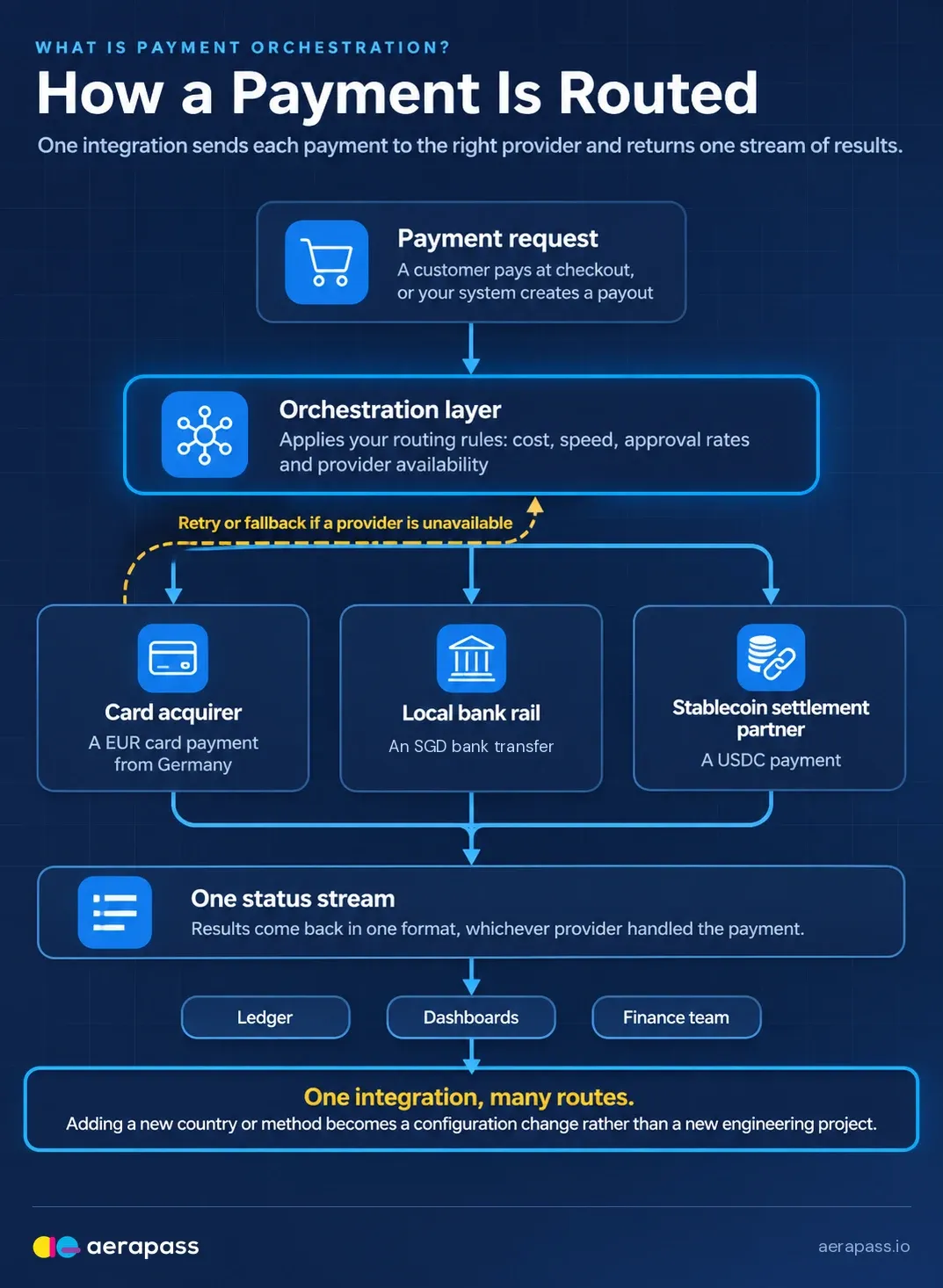
A typical payment through an orchestration layer follows five steps.
1. The payment request. A customer chooses a payment method in your checkout, or your system creates a payout. The request goes to the orchestration layer, not to a specific provider.
2. Routing decision. The layer applies your rules. A EUR card payment from Germany might go to one acquirer, an SGD bank transfer to a local rail, and a USDC payment to a stablecoin settlement partner. Rules can weigh cost, speed, approval rates and provider availability.
3. Processing. The chosen provider processes the payment. Sensitive card data is usually tokenised, so the layer can send the same customer’s payment to different providers without your systems storing card numbers.
4. Retry or fallback. If a provider declines for a technical reason or is unavailable, the layer can try another route, subject to the rules of the card scheme and the method used.
5. Status and reporting. The result comes back in one format, whichever provider handled it. Your ledger, dashboards and finance team see one stream of payment events instead of a different report from each provider.
Why Platforms Use Payment Orchestration
Local payment methods. Customers in different markets prefer different ways to pay. McKinsey notes that account-to-account networks such as India’s UPI and Brazil’s Pix have reached scale with minimal transaction fees (McKinsey). Supporting methods like these, market by market, is much easier through one layer than through one integration per provider.
Resilience. If your only provider has an outage, you cannot take payments. With more than one route available, payments can keep flowing.
Cost. Routing each payment over the most efficient provider or rail can lower processing and FX costs, especially for cross-border flows where fees vary widely by corridor.
One view of payments. Every provider reports differently. A single, normalised stream of payment events makes reconciliation, refunds and dispute handling far simpler. Our guide to multi-currency payment reconciliation covers that side in detail.
Speed to market. Adding a new country or method becomes a configuration change rather than a new engineering project.
Payment Orchestration vs Payment Gateway vs Payment Processor
These terms are often used interchangeably, but they describe different layers.
| Payment processor / acquirer | Payment gateway | Payment orchestration layer | |
|---|---|---|---|
| What it does | Processes and settles card or bank payments (the acquirer holds the merchant relationship and settles funds) | Securely passes payment details from your checkout to a processor | Manages many gateways, processors and rails through one integration |
| Number of providers | One (itself) | Usually one processor behind it | Many |
| Routing | None | Fixed | Rule-based, by cost, method, market or availability |
| Failover | No | Limited | Retries or reroutes where allowed |
| Reporting | Its own format | Its own format | One normalised format across providers |
For a deeper look at the gateway layer, see our guide to multi-currency payment gateways.
Want one hosted checkout for card, bank and crypto? Aerapass Hosted Payment Pages connect to underlying payment partners and handle orchestration behind a branded, configurable checkout, with real-time payment status and reporting. Explore Aerapass hosted payment pages
Do You Need a Payment Orchestration Platform?
Orchestration adds a layer, and every layer has a cost. It is usually worth it when:
- You accept payments in several countries or currencies, or plan to within the next year
- Your customers expect local payment methods your current provider does not support
- A single provider outage would stop revenue
- You pay out to sellers, suppliers or clients across borders as well as collecting payments
- Your finance team spends significant time reconciling reports from different providers
It is usually not worth it yet when you sell in one market, in one currency, through one provider that meets your needs. In that case, a well-chosen gateway is simpler.
There is also a build vs buy question. Some large platforms build their own routing layer. Most find it more practical to buy, because the hard part is not the routing logic but the provider connections, compliance and maintenance behind it. Our build vs buy framework sets out how to weigh that decision.
What to Look for in a Payment Orchestration Platform
- Coverage. Which providers, payment methods, currencies and countries are connected today, not just on the roadmap?
- Beyond cards. Does it handle bank transfers, local rails, payouts and stablecoin settlement, or only card acceptance?
- Routing control. Can you set and change rules yourself, by cost, method, market and availability?
- Compliance built in. How are KYC, AML and sanctions screening handled, and who is responsible for what?
- Data and reporting. Do you get one normalised record per payment, with fees and FX recorded, and real-time status updates?
- White-label options. Can the checkout and payment pages carry your brand rather than the provider’s?
- Time to launch. How long from contract to the first live payment?
Frequently Asked Questions
What is payment orchestration in simple terms?
Payment orchestration is a software layer that connects a business to several payment providers through one integration. It decides which provider or payment rail handles each payment, retries failed payments through another route where possible, and reports every payment in one consistent format, whichever provider processed it.
What is the difference between a payment gateway and payment orchestration?
A payment gateway securely passes payment details from a checkout to one payment processor. A payment orchestration layer sits above gateways and processors, connecting to many of them, routing each payment by rules such as cost, method or market, and combining their reporting into a single view.
What are the benefits of payment orchestration?
The main benefits are access to local payment methods in each market, resilience if one provider has an outage, lower processing and FX costs, faster expansion into new markets, and simpler reconciliation because every payment is reported in one format.
Who needs a payment orchestration platform?
Platforms that accept or send payments in several countries or currencies, need local payment methods, cannot afford to stop taking payments during a provider outage, or pay out to sellers and suppliers across borders. A business selling in one market through one provider usually does not need orchestration yet.
Does payment orchestration only apply to card payments?
No. It began with routing card transactions between acquirers, but it now covers bank transfers, local payment methods, real-time payment schemes, payouts and stablecoin settlement. For cross-border platforms, routing across these rails is often where the largest cost and speed differences sit.
How does payment orchestration help reconciliation?
Each payment provider reports in its own format, with different fields, fee structures and timings. An orchestration layer normalises these into one record per payment, with a consistent reference, status, fees and currency details. That makes it far easier to match payments against your ledger automatically.
Routing payments across borders? Aerapass runs SWIFT, SEPA, ACH, local rails and USDT and USDC settlement from one platform, so you can choose the right method for each transaction and reduce costs by routing over the most efficient rails. Explore Aerapass global payments
The content on this page is produced by Aerapass for general informational purposes only and does not constitute financial advice, investment advice, or any other form of professional advice. Aerapass is a technology platform provider serving financial institutions, wealth managers, and fintech companies. Before making any financial decision, you should consult with a qualified, licensed financial advisor who can take your individual objectives and circumstances into account.