
Virtual Cards: Benefits, Use Cases and Providers

Virtual Card Programs for Fintechs and Wealth Platforms: Benefits, Use Cases and How to Launch
Key Takeaways
- A virtual card program lets a business issue Visa or Mastercard card numbers to its customers, staff or suppliers through an API, with no plastic to produce or ship.
- Cards rarely stand alone. They work best on top of the multi-currency accounts, payments and onboarding a business already offers its clients, so the card spends balances clients already hold.
- The benefits for the business running the program are speed (cards are live the moment they are issued), control (limits, merchant categories, countries and instant freeze) and cards that are targeted by fraud less often than checks and bank transfers.
- The strongest use cases sit in two groups: neobanks that want customers spending on day one, and wealth managers that want a branded multi-currency card for their clients.
- Most programs launch with a card issuing provider that supplies BIN sponsorship, scheme connectivity, processing and compliance, so the business can focus on the product.
A virtual card is a payment card that exists only as data: a 16-digit card number, an expiry date and a security code. It works anywhere the card network is accepted online, and in stores once it is added to a digital wallet. For a consumer, that is the whole story. For a business, the interesting question is a different one: what changes when you can issue those cards yourself, in seconds, under your own brand, with rules attached to every card?
That is what a virtual card program is. This guide explains how one works, the benefits for the business that runs it, how neobanks and wealth managers use virtual cards alongside the accounts and payments they already offer, and what it takes to launch.
What Is a Virtual Card Program?
A virtual card program is a set of card products that a business issues to its own users through a card issuing provider. The business decides who gets a card, how it is funded, where it can be used and what it looks like. The provider handles the regulated and technical layers underneath: the bank identification number (BIN), the connection to Visa or Mastercard, transaction processing, fraud tools and compliance.
Virtual cards differ from physical cards in three practical ways:
| Virtual card | Physical card | |
|---|---|---|
| Time to first use | Seconds, through an API or dashboard | Days to weeks for production and delivery |
| Unit cost | No card stock, printing or postage | Card production, personalisation and shipping |
| Where it works | Online, in apps, and in stores through digital wallets | Online and in stores |
| Replacement after fraud | Freeze and reissue a new number instantly | Block, then wait for a new card to arrive |
Most programs run both. A neobank, for example, might issue a virtual card the moment an account opens and post a physical card to customers who want one. For a fuller comparison of prepaid, debit and virtual card products, see our guide to branded card programmes for fintechs.
Who does what in a virtual card program
Four parties sit behind every card:
- The program owner is the business whose brand is on the card: the neobank, wealth manager or platform.
- The issuer is the licensed institution that holds the BIN and issues the card under Visa or Mastercard scheme rules. Program owners without a banking licence work with an issuer through BIN sponsorship.
- The issuer processor authorises transactions in real time, applies the card controls and passes events back to the program owner.
- The program manager ties these together: setting up the program, running compliance and giving the program owner an API and dashboard.
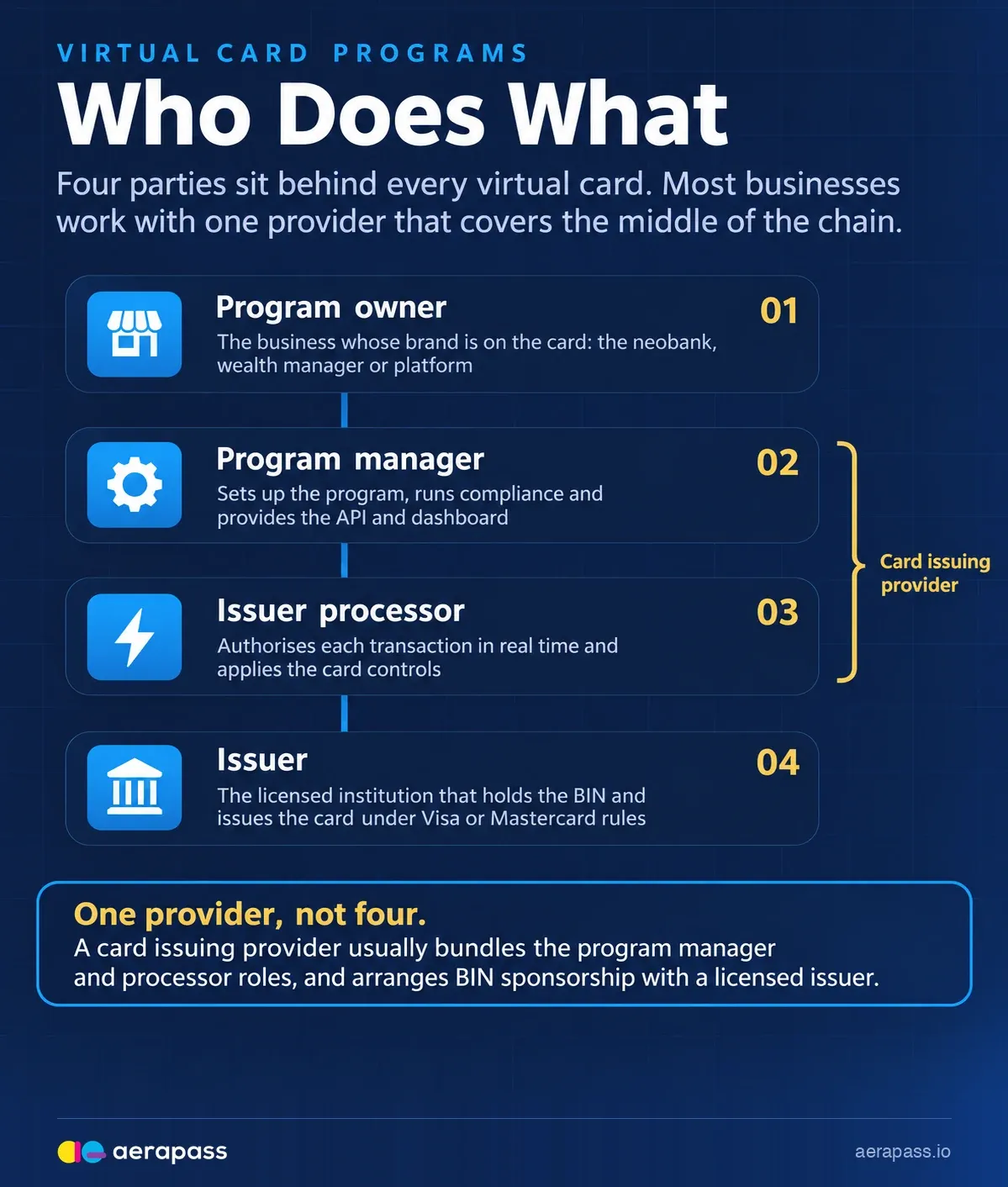
A card issuing provider usually bundles the processor and program manager roles, and arranges BIN sponsorship through its banking partners. That is why most businesses evaluate one provider rather than four. Our guide to what to evaluate in card issuing platforms covers that selection in detail.
The Benefits of Virtual Cards for the Business Running the Program
The benefits of virtual cards are usually described from the cardholder’s side: convenience and safety online. The case for running a program is about what the business gains.
1. Instant issuance
A virtual card can be created and used within seconds. The card number, expiry date and CVV are available as soon as the card is issued, so a new customer, employee or supplier can start paying straight away. For a business, that removes the gap between signing someone up and earning from their activity.
2. No production or shipping cost
Virtual cards remove card stock, printing, personalisation and postage, and the cost of replacing lost or damaged cards. That changes the economics of issuing cards for short-lived purposes: a single project, a trip or one supplier contract.
3. Control over every card
Each card can carry its own rules. Typical controls include spending limits, velocity rules (how many transactions in a period), merchant category restrictions, geographic restrictions and instant freeze and unfreeze. The card networks are building more of this into their own rails. In October 2026 Visa announced Visa Commercial Fraud Solutions, including Commercial Payment Controls, which let businesses “set transaction-level controls, including spend, merchant category, location and timing parameters” (Visa, October 2026).
4. Lower fraud exposure
Because a virtual card can be limited to one merchant, one amount or one period, a stolen card number is worth far less to a fraudster. Real-time authorisation also lets the program owner decline a transaction before it settles. Business payment data points the same way. In the 2026 AFP Payments Fraud and Control Survey, 58% of organisations reported check fraud in 2025, 30% ACH debit fraud and 25% wire fraud, while corporate cards, virtual cards, mobile wallets and cash “remained comparatively infrequent targets” (AFP, 2026 Payments Fraud and Control Survey Report, key highlights).
5. Multi-currency spending
A multi-currency card can hold several currency balances in one card account. When the cardholder pays, the program uses the balance in the matching currency. If there is no balance in that currency, conversion is applied based on the program’s FX setup. For cardholders who travel or buy from overseas suppliers, holding the right currencies in advance reduces how often they pay for conversion.
6. Real-time data
Every authorisation, approval, decline, freeze and dispute can be sent to the program owner’s systems as it happens. That makes reconciliation, expense reporting and customer notifications automatic rather than a month-end exercise.
7. Revenue and retention
For the program owner, cards earn interchange on spending, and a card that a customer uses every week keeps them active. Because the card spends balances held in accounts the business already runs, it also brings day-to-day activity onto those accounts instead of a third-party card.
Launching card products for your customers? Aerapass gives fintechs and neobanks multi-currency accounts, payments, card issuing and built-in compliance through one API. Explore our fintech and neobanking solutions
Virtual Card Use Cases
In both of the use cases below, the card is not the first product. It extends the accounts, payments and client services the business already provides, which is why the strongest programs are built on the same infrastructure as those services.
Neobanks and digital wallets
For a neobank, the first card is the product. A virtual card issued at account opening means the customer can spend before a physical card arrives, add the card to a digital wallet, and pay online on the same day. Neobanks typically combine that with:
- Spend controls the customer can set, such as a monthly limit or blocking a merchant category, which turn a card into a budgeting tool.
- Multi-currency balances and FX, for customers who travel or earn in more than one currency.
- Disposable or purpose-specific cards for online shopping and subscriptions, which can be frozen or replaced without touching the main card.
- Physical cards on request, issued from the same program, for customers who want plastic.
Digital wallet and payment app providers use the same model, embedding cards into their apps with programmable limits and funding rules. Card issuing is one of the most common forms of embedded finance, where financial products sit inside a product built for something else.
Wealth managers
A wealth manager’s clients hold cash in several currencies and move money between countries. A branded multi-currency card linked to those balances gives clients a way to spend directly, instead of asking for a transfer every time they travel or pay a bill abroad. It also changes the relationship. A client who only sees a quarterly report has little day-to-day contact with the firm; a client who uses the firm’s card every week does.
Typical uses include:
- Client cards in the firm’s brand, with multi-currency balances and limits agreed with the client.
- Travel spending without separate FX transfers before each trip.
- Relationship manager oversight, with the ability to freeze a card instantly if something looks wrong.
- Firm expense cards for staff, with category rules and real-time monitoring.
Cards sit alongside the other services a wealth manager offers clients, from onboarding to portfolio reporting. For how firms assemble those services, see our guide to white-label wealth management platforms and our solutions for wealth managers.
How to Launch a Virtual Card Program
Step 1: Define the program
Decide who the cardholders are (individuals, businesses or both), how cards are funded (prepaid balance, linked account or credit line), which currencies they hold, and whether the program needs physical cards as well. These choices determine the licensing and BIN sponsorship you need.
Step 2: Choose a virtual card provider
Most program owners do not hold an issuing licence, so the provider’s BIN sponsorship, scheme connections and regulatory coverage matter more than any single feature. Check whether the provider covers every market you plan to serve, whether it supports both Visa and Mastercard, and how quickly it can issue a first live card. Check too whether the same provider supports the accounts, payments and onboarding the cards will draw on, so balances, compliance checks and transaction data stay in one place.
Step 3: Set the controls and authentication
Configure limits, merchant category rules, country restrictions and velocity rules for each card product. Set up 3-D Secure authentication for online payments, including whether the authentication pages carry your brand.
Step 4: Integrate
Connect your app or back office to the provider’s API to create cards, change controls and receive real-time events: authorisation requests, approved and declined transactions, card lifecycle changes and disputes.
Step 5: Pilot, then scale
Start with a limited group of cardholders, review declines, fraud alerts and support requests, then widen the rollout. A program built on the right infrastructure should scale from a pilot to a large program without changing provider.
With established infrastructure, a typical launch takes four to six weeks, including compliance setup, program configuration and testing. Traditional card issuing projects often take several months; our build vs buy framework sets out how to weigh that choice.
Frequently Asked Questions
What is a virtual card program?
A virtual card program is a set of card products that a business issues to its customers, staff or suppliers through a card issuing provider. The business sets who gets a card, how it is funded and where it can be used. The provider supplies BIN sponsorship, Visa or Mastercard connectivity, transaction processing, fraud tools and compliance.
What are the benefits of virtual cards for businesses?
The main benefits are instant issuance, no card production or shipping cost, detailed controls on every card (limits, merchant categories, countries and instant freeze), cards that are targeted by fraud less often than checks and bank transfers, multi-currency spending and real-time transaction data for reconciliation.
What does a virtual card issuer do?
A virtual card issuer is the licensed institution that holds the bank identification number (BIN) and issues cards under Visa or Mastercard rules. Businesses without an issuing licence work with an issuer through BIN sponsorship, usually arranged by a card issuing provider that also handles processing and program management.
How can a neobank launch virtual and physical cards with spend controls and FX support?
A neobank typically works with a virtual card provider that offers BIN sponsorship, both card networks and multi-currency card accounts. It issues a virtual card at account opening, lets customers set limits and block merchant categories in the app, holds balances in several currencies, and offers a physical card from the same program on request.
How do wealth managers use virtual cards?
Wealth managers issue branded multi-currency cards linked to client balances, so clients can spend and travel without requesting a transfer each time. Relationship managers can see activity and freeze a card instantly, and the same program can provide expense cards for the firm’s own staff.
How long does it take to launch a virtual card program?
With established card issuing infrastructure, a typical launch takes four to six weeks, including compliance setup, program configuration and testing. Building card issuing in-house, with your own scheme membership and processing, often takes several months.
Ready to launch a virtual card program? Aerapass issues virtual and physical Visa and Mastercard cards, single or multi-currency, with real-time controls, webhooks and instant issuance, alongside multi-currency accounts, global payments and onboarding through one API. Explore Aerapass card issuance
The content on this page is produced by Aerapass for general informational purposes only and does not constitute financial advice, investment advice, or any other form of professional advice. Aerapass is a technology platform provider serving financial institutions, wealth managers, and fintech companies. Before making any financial decision, you should consult with a qualified, licensed financial advisor who can take your individual objectives and circumstances into account.