
What Is Embedded Finance? A Platform Guide

What Is Embedded Finance? A Guide for Platforms and Financial Institutions
Key Takeaways
- Embedded finance means offering financial services, such as payments, accounts, cards, lending, insurance or investing, inside a product whose main job is something else, at the moment a customer needs them.
- It is growing fast. Juniper Research forecasts global embedded finance revenue will rise from $162.6 billion in 2026 to $617 billion in 2031, with B2B revenue growing 390% (Juniper Research, Embedded Finance Market 2026-31).
- Asia-Pacific businesses are the keenest. In Global Payments’ 2026 Trends Report, 98% of Asia-Pacific respondents planned to invest in embedded finance, against 70% in Europe and 54% in North America (Asian Banking & Finance, April 2026).
- Every embedded finance product involves three parties: the brand that owns the customer, the platform that supplies the technology, and the licensed institution that carries the regulated activity.
- The licence never moves with the brand. Choosing a provider is mostly a question of who holds which licences, in which markets, and how compliance responsibilities are shared.
Embedded finance is the reason a ride-hailing app can pay its drivers instantly, an online store can offer instalments at checkout, and an accounting tool can open a business account. In each case the customer never visits a bank. The financial service appears inside a product they already use, at the point where they need it.
For businesses, that shift is both an opportunity and a design problem. Embedding a financial product can add revenue and keep customers closer, but it also brings regulated activity into a business that was not built to run it. This guide explains what embedded finance is, the main types, who does what behind the scenes, why it is accelerating in 2026, and what to look for in an embedded finance platform.
What Is Embedded Finance?
Embedded finance is the integration of financial services into a non-financial product or customer journey, so that the customer can pay, borrow, save, insure or invest without leaving that product. The service is delivered by a licensed institution through technology provided by a platform, while the brand keeps the customer relationship.
Three features separate embedded finance from simply partnering with a bank:
- Context. The financial service appears inside a specific journey, such as checkout, payroll, booking or onboarding, rather than as a standalone product.
- Branding. The customer sees the brand they already use, not the bank or platform behind it.
- Integration through APIs. The financial service is built into the product’s own screens and data, rather than handed off to another website.
Embedded finance is closely related to Banking as a Service (BaaS), and the two terms are often used interchangeably. In short, BaaS is the infrastructure model that lets non-banks access regulated banking products, and embedded finance is the distribution model that puts those products inside other experiences. Our guide to Banking as a Service covers the difference in detail.
Types of Embedded Finance
| Type | What the customer sees | Typical examples |
|---|---|---|
| Embedded payments | Pay or get paid without leaving the app | Checkout, marketplace payouts, driver payments, invoice collection |
| Embedded accounts and wallets | A balance held inside the product | Seller wallets, multi-currency business accounts, stored value |
| Embedded cards | A card issued by the brand | Expense cards, wallet cards, marketplace buyer and seller cards |
| Embedded lending | Credit offered in context | Instalments at checkout, merchant cash advances, invoice financing |
| Embedded insurance | Cover offered at purchase | Travel cover at booking, device protection, shipment insurance |
| Embedded investing and wealth | Investment products inside a non-investment app | Savings pots, fractional or tokenized assets, portfolio access in a banking app |
| Embedded FX and cross-border payments | Currency conversion and international transfers in the flow | Paying overseas suppliers from accounting software, multi-currency payouts |
Embedded payments
Payments are the most widespread form of embedded finance, and usually the first one a platform adds. McKinsey’s 2026 Global Payments Report describes the effect: “As software embeds transaction flows, value relocates to the underlying control layer: machine identity credentials, consent frameworks, dynamic routing, and policy guardrails” (McKinsey, The 2026 Global Payments Report). In plain terms, the checkout screen matters less than the infrastructure that decides how, where and under what rules money moves. For payments accepted in many currencies, see our guide to multi-currency payment gateways.
Embedded cards
Card issuing lets a platform give its users a branded Visa or Mastercard card, often virtual first, with spending controls set by the platform. It is one of the fastest ways to make an embedded product part of a customer’s daily routine. Our guide to virtual card programs covers the benefits and use cases, and our card issuance platform page shows how the cards are issued and managed.
Embedded investing and wealth
Embedded finance is no longer limited to payments and credit. Banking apps add investment portfolios, payment apps add savings and gold, and wealth managers embed payments, cards and FX into their own client experience. For a wealth firm, this is the same idea in reverse: rather than a non-financial brand adding finance, an investment firm adds everyday money services so clients can spend, transfer and convert currencies without leaving the firm. Our guide on how wealth platforms add tokenized gold shows one example, and our wealth management platform page covers the wider set of services.
How Embedded Finance Works
Behind every embedded finance product sit three parties:
- The brand. The software company, marketplace, retailer or financial firm that owns the customer relationship and decides where the financial service appears.
- The embedded finance platform. The technology provider that exposes accounts, payments, cards, FX or other services through APIs, and usually runs the compliance processes the regulated activity requires, such as KYC, AML screening and transaction monitoring.
- The licensed institution. The bank, payment institution or other licence holder that is legally responsible for the regulated activity, such as safeguarding customer funds or issuing cards.
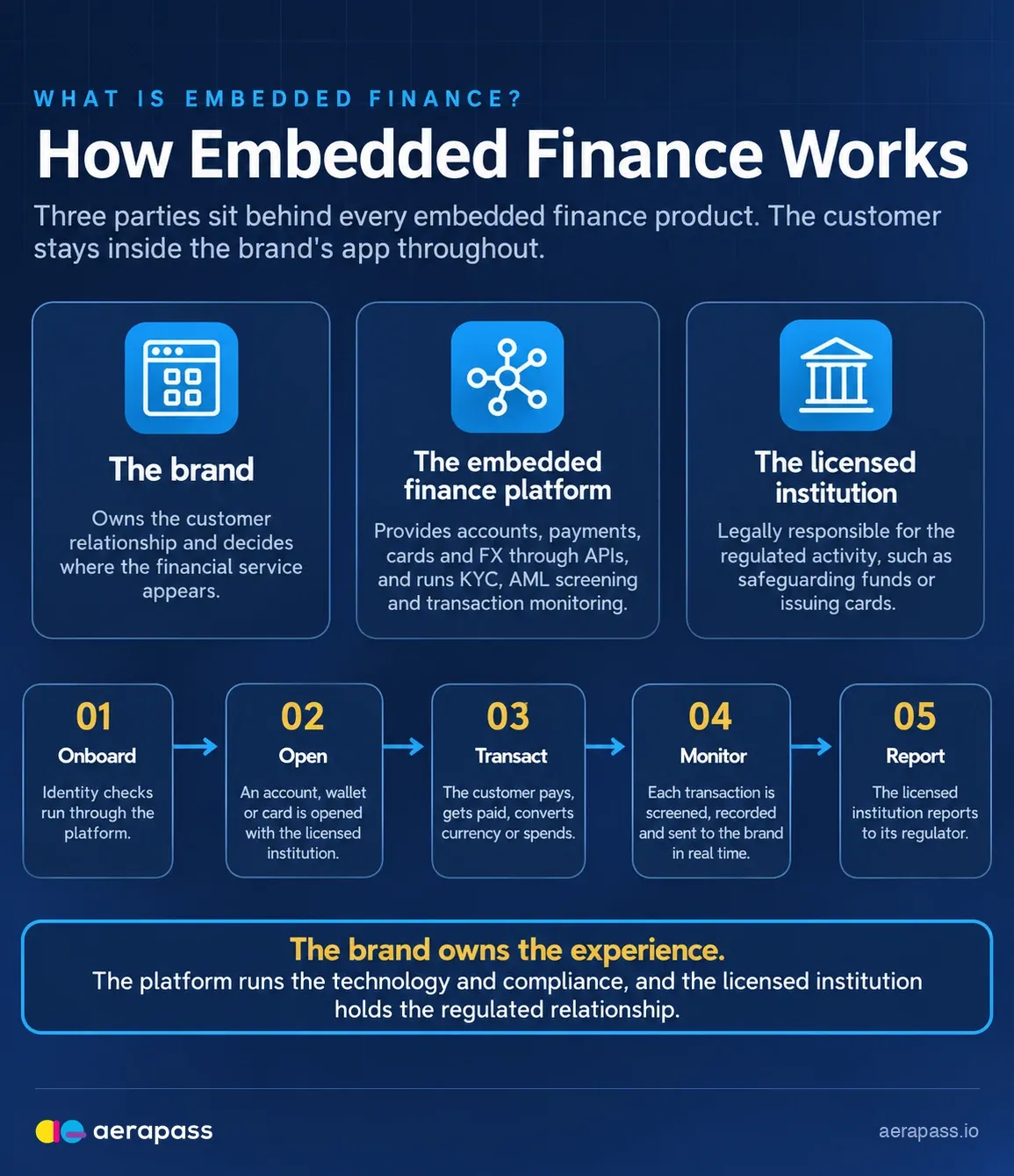
Sometimes the platform and the licensed institution are the same company. Sometimes the platform works with several licensed partners across markets. Either way, a typical flow looks like this:
- The brand’s customer is onboarded inside the brand’s app, with identity checks run through the platform.
- The platform opens an account, wallet or card for that customer with the licensed institution.
- The customer pays, gets paid, converts currency or spends with a card in the brand’s app.
- The platform screens and records each transaction, and sends real-time events back to the brand’s systems.
- The licensed institution holds the regulated relationship and reports to its regulator.
For a technical view of the architecture underneath, including sponsor banks, ledgers and webhooks, see how BaaS works.
Why Embedded Finance Is Accelerating
The revenue opportunity is large and shifting to B2B
Juniper Research’s September 2026 forecast puts global embedded finance revenue at $162.6 billion in 2026, rising to $617 billion by 2031, with B2B revenue growing 390% over the period (Juniper Research). B2B growth matters because business software, procurement and payroll tools sit at the centre of how companies move money.
Asia-Pacific is leading on intent
The 98% of Asia-Pacific respondents planning to invest in embedded finance in Global Payments’ 2026 Trends Report compares with 54% in North America (Asian Banking & Finance). Super-apps, high digital wallet use and cross-border trade make the region a natural fit for embedded models.
Software is taking the customer relationship
McKinsey recommends that providers “embed payment software directly within enterprise resource planning and procurement systems to protect customer relationships from commoditization” (McKinsey, 2026). The same logic applies to banks and wealth firms: the institution that is present inside the customer’s daily tools is the one that keeps the relationship.
Building embedded financial products? Aerapass gives fintechs and digital platforms multi-currency accounts, payments, card issuing and built-in compliance through embedded finance APIs. Explore our fintech and neobanking solutions
Benefits and Risks for the Brand
Benefits
- New revenue. Payment fees, interchange on card spending, FX margins and lending income add to core product revenue.
- Retention. A customer whose money and payments run through a product is less likely to switch away from it.
- Better data. Transaction data shows how customers actually operate, which improves both the product and risk decisions.
- Simpler journeys. Customers complete payments, payouts and currency conversions without leaving the product.
Risks
- Regulatory responsibility. The licence sits with the regulated institution, but the brand still shapes the customer experience, marketing and complaints handling. Responsibilities need to be written down and agreed.
- Partner dependency. If a provider or its licensed partner fails, the brand’s customers are affected. Ask how customer funds are safeguarded and what happens if a partner exits.
- Compliance load. Onboarding, sanctions screening and transaction monitoring must work for every customer and every market. Our guide to reducing KYC friction covers how to keep onboarding fast without weakening checks.
- Fragmented markets. Each country licenses financial services differently. In Singapore, for example, payment services are regulated under the Payment Services Act 2019, with separate licence classes such as Standard Payment Institution and Major Payment Institution (MAS, Payment Services Act 2019). A product that works in one market may need a different licensed partner in the next.
What to Look for in an Embedded Finance Platform
- Licence coverage. Which licences does the platform or its partners hold, and in which markets? Coverage across the markets you plan to enter matters more than any single feature.
- Breadth of products. Can accounts, payments, cards and FX be added through one integration, or does each need a separate provider?
- Compliance built in. KYC, AML screening and transaction monitoring should be part of the platform, with clear lines on who is responsible for what.
- White-label control. Your brand, your screens and your customer communications, with the platform invisible to the end customer.
- API quality. Clear documentation, sandbox testing, idempotent requests and real-time webhooks for every event.
- Multi-currency support. Balances, payouts and conversions across the currencies your customers use.
- Time to launch. How long from contract to first live customer, and what is needed from your team.
Many firms weigh building some of these capabilities in-house against buying them. Our build vs buy framework sets out how to make that decision.
Frequently Asked Questions
What is embedded finance in simple terms?
Embedded finance means offering financial services, such as payments, accounts, cards, loans, insurance or investing, inside a product whose main purpose is something else. The customer uses the service in an app they already know, while a licensed institution and a technology platform handle the regulated and technical work behind the scenes.
What are examples of embedded finance?
Common examples include instalment payments at an online checkout, instant payouts to drivers or sellers in a marketplace app, branded cards issued by an expense management tool, business accounts opened inside accounting software, travel insurance offered at booking, and investment or gold savings features inside a payment app.
What is the difference between embedded finance and BaaS?
Banking as a Service is the infrastructure model that lets non-banks access regulated banking products through APIs. Embedded finance is the distribution model that places those products inside non-financial experiences. Most embedded finance runs on BaaS infrastructure, but a standalone neobank can use BaaS without being embedded in another product.
Who regulates embedded finance?
Embedded finance itself is not a licence category. Regulators license the underlying activity, such as payment services, e-money, card issuing or lending, and the institution carrying out that activity holds the licence. In Singapore, payment services are regulated by the Monetary Authority of Singapore under the Payment Services Act 2019.
What is an embedded finance platform?
An embedded finance platform is a technology provider that lets a business add financial services to its product through APIs. It typically supplies accounts, payments, cards or FX, runs compliance processes such as KYC and transaction monitoring, and works with or holds the licences needed in each market.
How big is the embedded finance market?
Juniper Research forecasts global embedded finance revenue of $162.6 billion in 2026, rising to $617 billion by 2031, with B2B embedded finance revenue growing 390% over that period.
Ready to embed payments in your product? Aerapass provides cross-border payments, multi-currency accounts and FX through one API, with compliance built in. Explore Aerapass global payments
The content on this page is produced by Aerapass for general informational purposes only and does not constitute financial advice, investment advice, or any other form of professional advice. Aerapass is a technology platform provider serving financial institutions, wealth managers, and fintech companies. Before making any financial decision, you should consult with a qualified, licensed financial advisor who can take your individual objectives and circumstances into account.