What Is Wealthtech? A Guide for Wealth Managers

What Is Wealthtech? How Wealth Technology Is Changing Wealth Management
Key Takeaways
- Wealthtech is technology that automates the delivery of wealth management and investment services, covering client onboarding, portfolio management, trading, payments, custody connectivity and reporting.
- Clients are ahead of most firms: only 17% of high-net-worth individuals say their advice feels seamless and tailored, and 42% have to restate their goals to the same firm several times (Capgemini, World Wealth Report 2026).
- BCG reports that independent wealth managers face margin pressure from compliance and rising technology requirements, and that custodian banks and platform providers are becoming “de facto operating systems for sub-scale IWMs”, though it warns this “creates dependency” (BCG, Global Wealth Report 2026).
- Hong Kong and Singapore are growing fast as wealth centers. Hong Kong’s asset and wealth management AUM rose 20% in 2025 to HK$42.2 trillion (SFC), and Singapore’s grew 10% to S$6.7 trillion (MAS).
- The real choice for most firms is not whether to adopt wealthtech, but whether to build it, assemble it from point solutions, or run on a white-label platform under their own brand.
Wealthtech is the technology that wealth managers, family offices and private banks use to onboard clients, manage portfolios, execute trades, move money and report to clients. The CFA Institute has described wealthtech firms as using technology “to automate the delivery of wealth management and investment services”, enabling “end-to-end digitization of a retail investor’s investment process” (CFA Institute Research and Policy Center).
For a firm running client money, that description covers a lot of ground. It includes the robo-advice apps that made the word popular, but it also includes the less visible systems behind every relationship: KYC onboarding checks, multi-currency accounts, trade execution, custody connections and the reports a client reads each quarter. This guide explains what wealthtech covers, why it matters more in 2026 than it did five years ago, and how to decide what to build and what to buy.
What Is Wealthtech?
Wealthtech is a subset of fintech focused on wealth and asset management. Where fintech covers all financial services, from payments to lending to insurance, wealthtech serves the people who manage investments for others and the clients they serve.
Rather than define “wealthtech” itself, regulators in the major wealth centers regulate its most visible part, digital advice:
- Singapore. The Monetary Authority of Singapore describes digital advisers as providing advice “through direct access to automated, algorithm-based tools” with limited or no human interaction. It also notes that conventional advisers “may rely on similar algorithm-based tools at the back-end” (MAS, Guidelines on Provision of Digital Advisory Services). MAS treats its licensing framework as “technology agnostic”, so there is no separate licence for digital advice.
- Hong Kong. The Securities and Futures Commission describes robo-advice as financial advice “in an online environment using algorithms and other technology tools”, ranging from full automation to adviser-assisted models (SFC, Guidelines on Online Distribution and Advisory Platforms).
- Australia. ASIC defines digital advice as “automated financial product advice using algorithms and technology and without the direct involvement of a human adviser” (ASIC, Regulatory Guide 255).
These definitions matter because they show where regulators draw the line: the rules follow the activity, not the technology. A wealth manager using software to advise clients carries the same obligations as one using a spreadsheet. Wealthtech changes how the work is done, not who is accountable for it.
Wealthtech vs Fintech
| Fintech (broad) | Wealthtech | |
|---|---|---|
| Who it serves | Consumers, businesses and financial institutions across all services | Wealth managers, family offices, private banks, trust companies and their clients |
| Typical products | Payments, lending, neobanking, insurance, remittance | Onboarding and KYC, portfolio management, trading, reporting, custody connectivity, advice tools |
| What success looks like | Transaction volume, user growth | Client retention, assets under management, adviser capacity |
| Regulatory focus | Payments, deposits, consumer credit | Suitability, client asset protection, investment advice |
The Wealthtech Stack: What a Platform Covers
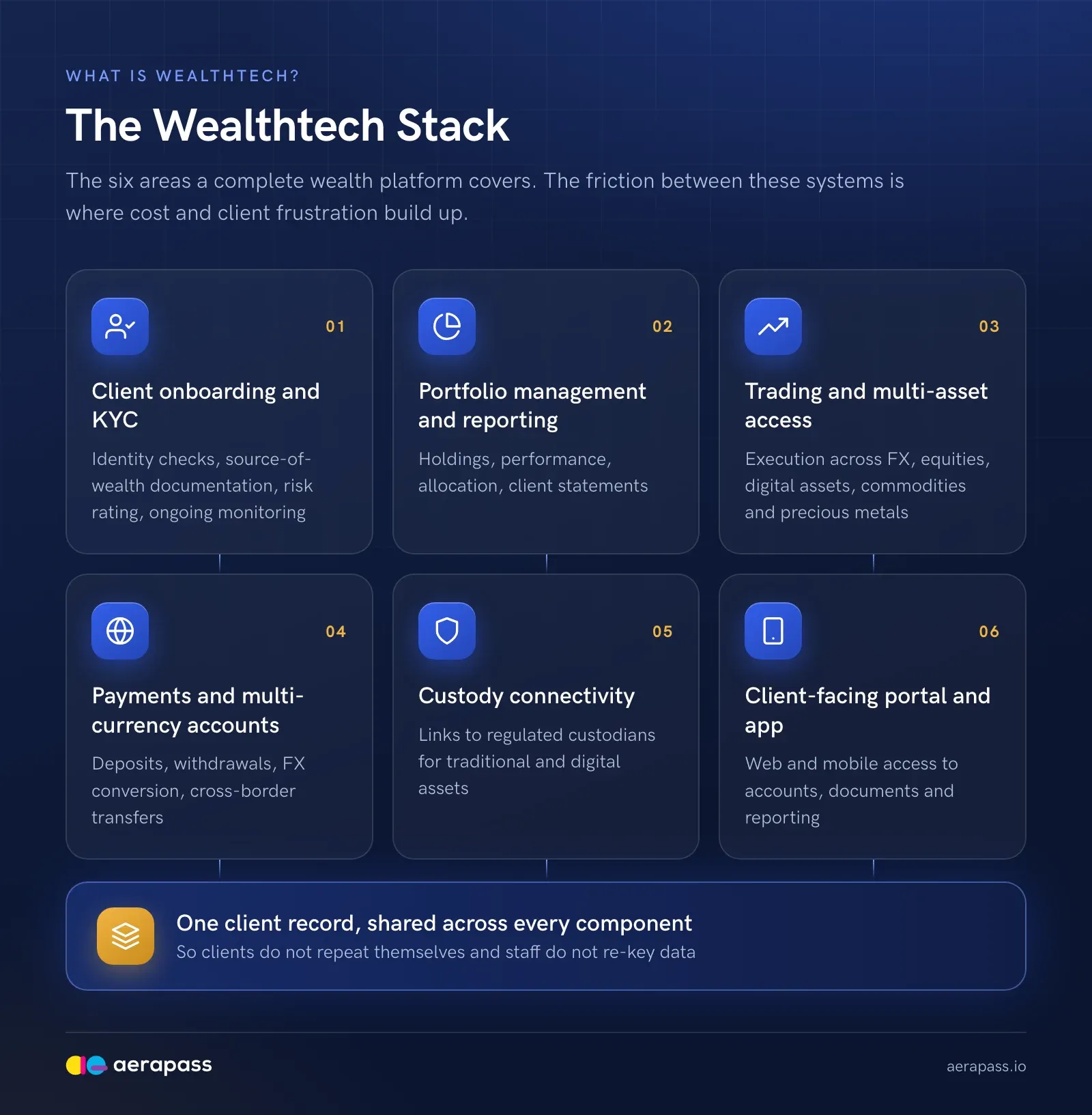
Most wealth firms do not buy “wealthtech” as one product. They run a stack of systems, and the friction between those systems is where cost and client frustration build up. A complete stack covers six areas:
| Component | What it does | Why it matters |
|---|---|---|
| Client onboarding and KYC | Identity checks, source-of-wealth documentation, risk rating, ongoing monitoring | Sets how fast a client can start investing, and how defensible the file is when a regulator asks |
| Portfolio management and reporting | Holdings, performance, allocation, client statements | The part of the service the client sees most often |
| Trading and multi-asset access | Execution across FX, equities, digital assets, commodities and precious metals | Clients increasingly expect one relationship to cover more asset classes |
| Payments and multi-currency accounts | Deposits, withdrawals, FX conversion, cross-border transfers | Cross-border clients need money to move as easily as their investments |
| Custody connectivity | Links to regulated custodians for traditional and digital assets | Lets client assets sit with regulated custodians while the firm keeps one view of the client |
| Client-facing portal and app | Web and mobile access to accounts, documents and reporting | Where the firm’s brand meets the client |
BCG’s advice on AI adoption points to the same structural issue. It recommends that wealth managers introduce “a decoupled data layer” that delivers “real-time, API-accessible, curated data”, with every action governed by transaction systems, rules engines and workflows (BCG, AI and the New Economics of Wealth Management). In plain terms, the components above need to share data cleanly before any new tool, AI or otherwise, can deliver much. We look at why in our piece on data quality challenges for AI and ML models.
Client onboarding is a good example. It touches identity checks, risk rating, account opening and ongoing reviews, which is why we cover it in depth in our guide to client lifecycle management for financial platforms. Custody is another; our guide to digital asset custody for financial institutions explains the custody models and what to check before adding digital assets.
Why Wealthtech Matters Now
Three pressures have moved wealthtech from a nice-to-have to an operating requirement.
1. Clients expect more, and loyalty is thinning
Capgemini’s World Wealth Report 2026 found that only 17% of high-net-worth individuals (HNWIs) say the advice they receive “feels seamless and tailored to their individual situation”, while 42% report having to restate their goals and preferences multiple times to the same firm (Capgemini, World Wealth Report 2026).
The same study shows what happens when clients are underserved. In 2019, 39% of HNWIs worked with a single firm for their wealth management needs. By 2025, that figure had fallen to 19%. And 88% say they work with multiple firms to get better access to alternative investments. Half of HNWIs also consider access to digital assets an important factor when selecting a wealth manager, yet Capgemini notes that many traditional firms “lack the secure custody infrastructure and specialist expertise needed to support this demand”.
These figures come from a single study, but the direction is clear: clients now compare their wealth manager’s experience with the best digital service they use anywhere, and they spread their assets when one firm falls short. That makes client retention as much a technology question as a service one.
2. Margins are under pressure
BCG’s Global Wealth Report 2026 describes independent wealth managers’ margins as under pressure “from compliance burdens, retrocession restrictions, and rising technology and cyber resilience requirements”, while clients “expect bank-grade reporting, mobile access, and AI-enabled interaction” (BCG, Global Wealth Report 2026).
Manual work is a large part of that cost. Capgemini found that nearly 40% of wealth executives say relationship managers still perform operational functions manually, and 76% of relationship managers want digital and AI-enabled systems that automate routine work.
Capacity is tightening too. In the US, McKinsey notes that nearly 40% of advisers are expected to retire within a decade, leaving a shortfall of roughly 100,000 professionals (McKinsey, US wealth management in 2035). Firms that cannot hire their way to growth have to get more from the advisers they have.
3. AI rewards firms with clean infrastructure
BCG estimates that AI-first wealth managers could gain 25-30% capacity across key workflows and increase revenue per adviser by 15-20% (BCG press release). It names financial planning, portfolio management and compliance automation as both the largest cost pools and the clearest near-term AI applications (BCG).
The same analysis carries a warning: “Those with fragmented systems will struggle to move beyond pilots regardless of how clearly they understand the opportunity.” AI does not fix a disconnected stack. It exposes it.
Wealthtech in Asia-Pacific’s Wealth Centers
Asia-Pacific is where the pressure and the opportunity are greatest. Capgemini reports that Asia-Pacific posted the highest regional growth in 2025, with HNWI wealth up 10.5% and HNWI population up 9.4% (Capgemini).
- Hong Kong overtook Switzerland in 2025 as the world’s largest cross-border wealth hub, with US$2.9 trillion in cross-border wealth booked there, according to BCG (BCG press release). The SFC’s own survey shows private banking and private wealth management AUM in Hong Kong grew 24% in 2025 to HK$12.9 trillion (SFC).
- Singapore’s AUM grew 10% to S$6.7 trillion in 2025, with 76% sourced from outside Singapore (MAS, Singapore Asset Management Survey 2025). More than 2,000 single family offices were receiving tax incentives as at end-December 2025 (MAS). For firms setting up there, see our Singapore family office launch playbook.
A wealth transfer is also beginning. UBS estimates that US$83 trillion in private wealth will change hands globally over the next two to three decades (UBS, Global Next Generation Report 2026). In Southeast Asia, BCG notes that 40-50% of major enterprises in Singapore, Malaysia and Indonesia remain founder-led, with median leadership ages above 70 (BCG press release). The next generation of clients is likely to expect digital access as standard.
The growth is international by nature. With 76% of Singapore’s AUM sourced from abroad, a typical firm serves clients in several countries, several currencies and several sets of rules. That is the gap wealthtech has to close: one client experience across multiple markets.
Serving clients across multiple wealth centers? Aerapass gives wealth managers and family offices onboarding, portfolio reporting, multi-asset trading, payments and custody connectivity in one white-label platform. Explore our solutions for wealth managers
Build, Assemble or White-Label?
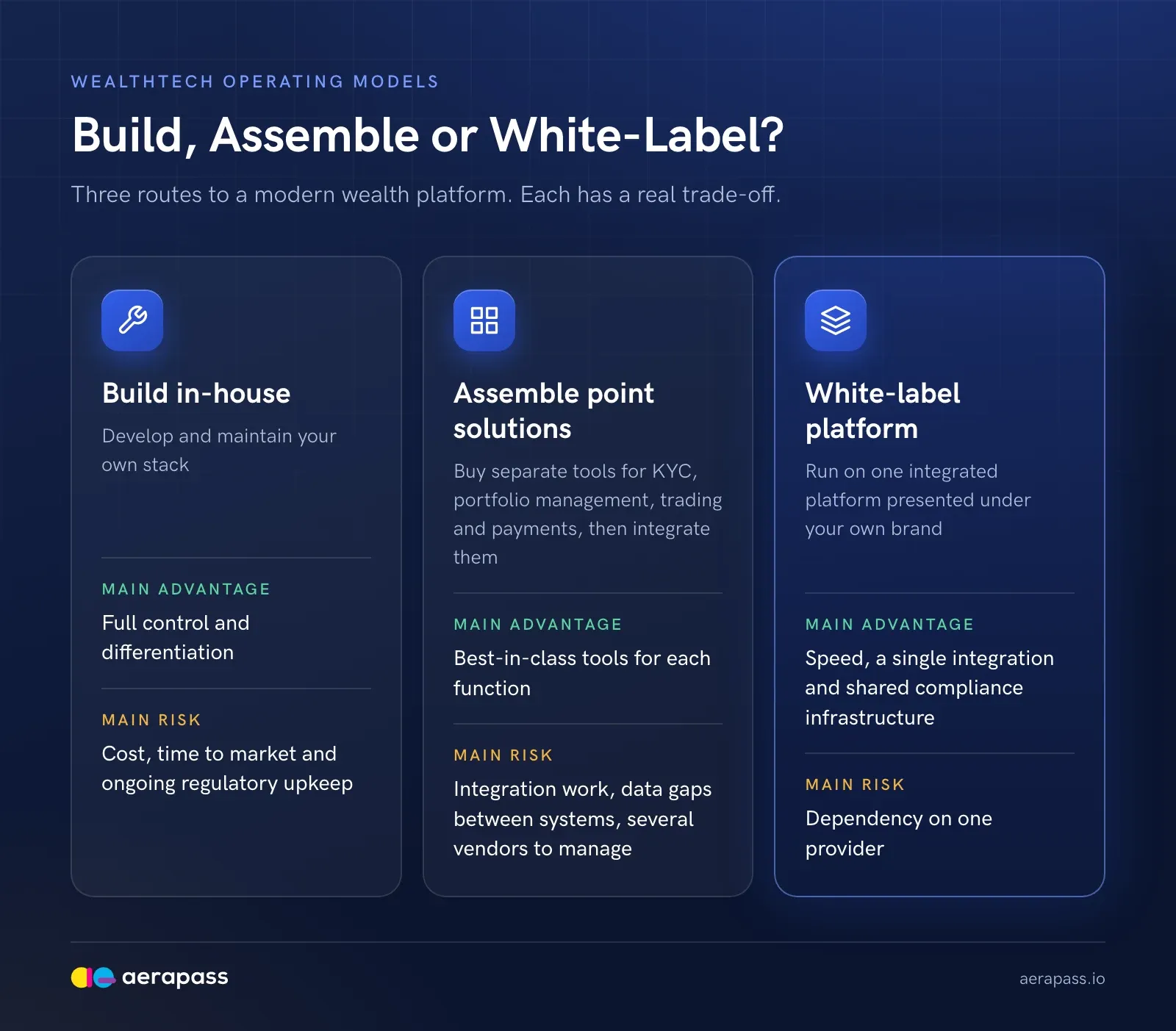
Once a firm decides to modernize, it faces three routes. Each has a real trade-off.
| Route | What it means | Main advantage | Main risk |
|---|---|---|---|
| Build in-house | Develop and maintain your own stack | Full control and differentiation | Cost, time to market and ongoing regulatory upkeep |
| Assemble point solutions | Buy separate tools for KYC, portfolio management, trading and payments, then integrate them | Best-in-class tools for each function | Integration work, data gaps between systems, several vendors to manage |
| White-label platform | Run on one integrated platform presented under your own brand | Speed, a single integration and shared compliance infrastructure | Dependency on one provider |
BCG observes that “custodian banks and platform providers are becoming de facto operating systems for sub-scale IWMs”, and it adds a fair caution: that relationship “creates dependency and shifts the financial benefits upstream” (BCG).
That caution is the strongest argument for choosing carefully. A white-label model works when the firm keeps the client relationship, the brand and the data, and the platform provides the infrastructure underneath. It works badly when the provider owns the client experience. We cover the economics in more detail in our fintech build vs buy decision framework and explain why independent wealth managers are switching to white-label platforms.
Regulation also allows for outsourcing, with conditions. In Singapore, MAS guidance states that a digital adviser can outsource the development and maintenance of its client-facing tools to a third-party provider, and that the provider “is not required to be licensed by MAS if it does not carry out financial advisory services, fund management or dealing activities directly for clients”. The firm must still apply “appropriate due diligence processes” to that provider (MAS). Accountability stays with the licensed firm, whichever route it takes.
What to Look for in a Wealthtech Platform
A full evaluation framework is set out in our 7-point guide to choosing wealth management software. At the category level, five questions separate a platform from a point solution:
- Does it cover the whole client lifecycle? Onboarding, portfolio management, trading, payments and reporting should share one client record, so clients do not repeat themselves and staff do not re-key data.
- Does it support the assets your clients want? Capgemini’s finding that 50% of HNWIs weigh digital asset access when choosing a manager makes multi-asset trading support, including tokenized gold and other digital assets, a selection criterion rather than an extra.
- Does it work across your markets? Clients booked in one center often live, bank and invest in others. Check multi-currency support and whether the provider holds the licences relevant to your markets.
- Can it carry your brand? A white-label wealth management platform should let you own the client experience end to end.
- Is the data accessible? Open APIs and a clean data model decide whether you can add AI tools, analytics or new products later without a rebuild.
Aerapass was built around these questions. Its wealth management, customer management, multi-asset exchange and global payments modules run on one API-first platform under the client’s own brand, with custody supported through integrations with regulated custodians. Aerapass is licensed in four major wealth centers - Hong Kong, Singapore, Australia and Canada.
Frequently Asked Questions
What is wealthtech in simple terms?
Wealthtech is technology that helps wealth managers, family offices and private banks serve investment clients. It covers client onboarding and KYC, portfolio management, trading, payments, custody connectivity and client reporting, delivered through software and apps rather than manual processes.
What is the difference between wealthtech and fintech?
Fintech covers all financial services, including payments, lending and insurance. Wealthtech is the part of fintech that serves wealth and asset management. Its users are wealth managers and their clients, and its success is measured in client retention, assets under management and adviser capacity.
Is wealthtech the same as robo-advice?
No. Robo-advice, or digital advice, is one part of wealthtech: automated, algorithm-based investment advice. Wealthtech also includes the systems behind human-led advice, such as onboarding, portfolio reporting, trade execution and payments.
Do wealthtech platforms need a licence?
It depends on the activity and the market. Regulators such as MAS treat their licensing frameworks as technology agnostic, so the obligations follow the regulated activity rather than the software. In Singapore, a third-party provider that develops client-facing tools for a licensed digital adviser, and does not provide financial advisory services, fund management or dealing activities directly for clients, does not itself need a MAS licence. The digital adviser remains subject to its own licensing obligations and must still carry out due diligence on the provider. Firms should take legal advice for their own situation.
Why are wealth managers adopting wealthtech now?
Client expectations, margin pressure and AI are converging. Capgemini found that only 17% of HNWIs say their advice feels seamless and tailored. BCG reports rising compliance and technology costs for independent wealth managers. BCG also warns that firms with fragmented systems will struggle to scale AI beyond pilots.
Ready to modernize your wealth platform under your own brand? Aerapass combines onboarding, portfolio reporting, multi-asset trading and global payments in one API-first platform. Explore the Aerapass wealth management platform
Regulatory Disclosure: Aerapass is licensed in four major wealth centers - Hong Kong, Singapore, Australia and Canada. This article is for educational and informational purposes only and does not constitute investment, financial, legal, or regulatory advice. Regulatory requirements vary by jurisdiction and change over time. Firms should consult qualified legal and compliance advisors in each market they serve. Data cited from Capgemini, BCG, McKinsey, UBS, the SFC, MAS, ASIC and the CFA Institute was correct at the time of writing.
The content on this page is produced by Aerapass for general informational purposes only and does not constitute financial advice, investment advice, or any other form of professional advice. Aerapass is a technology platform provider serving financial institutions, wealth managers, and fintech companies. Before making any financial decision, you should consult with a qualified, licensed financial advisor who can take your individual objectives and circumstances into account.