
Why Wealth Managers Switch to White-Label

Key Takeaways
- Independent wealth managers spend $105,000-430,000 annually maintaining legacy technology - most of it on compliance updates and IT infrastructure, not client-facing features
- Fintech competitors have reset client expectations: real-time portfolio access, automated reporting, and multi-asset dashboards are baseline requirements
- Modern platforms (SaaS, white-label, or custom-built) reduce time to market from 12-18 months to as little as 2-4 weeks
- Alternative asset classes including tokenized real estate and digital commodities require infrastructure legacy systems cannot support without 3-6 months of custom development
- The emerging super-app model - where a single platform provides portfolio management, payments, cards, and compliance - is creating a new competitive divide
The wealth management industry is undergoing a structural transformation. Research from Capgemini and Deloitte confirms a consistent trend: independent wealth managers - traditionally the most agile segment of the financial advisory landscape - are increasingly abandoning legacy technology stacks in favor of modern platforms that offer institutional-grade infrastructure without the institutional price tag.
This shift isn’t driven by a single factor. It’s the convergence of cost pressure, competitive threats from fintech disruptors, client demand for alternative assets, and the emerging super-app model that’s making the old way of operating increasingly untenable.
The Hidden Cost of Legacy Systems
What Legacy Wealth Management Technology Really Costs
For many independent wealth managers, the true cost of maintaining legacy technology becomes apparent only when it’s too late. The expenses extend far beyond the initial licensing fees:
Direct costs:
- Annual software licensing: $15,000-75,000+
- Compliance and regulatory updates: $10,000-40,000/year
- IT infrastructure and maintenance: $25,000-100,000+/year
- Staff training on outdated interfaces: $5,000-15,000/year
Indirect costs:
- Client attrition due to poor digital experience
- Opportunity cost of manual processes (reporting, rebalancing, compliance)
- Regulatory risk from delayed compliance updates
- Inability to offer new asset classes or services
Legacy vs Modern Platform: A Cost Comparison
| Cost Category | Legacy System (Annual) | Modern Platform (Annual) |
|---|---|---|
| Software licensing | $15,000-75,000 | Included in platform fee |
| Compliance updates | $10,000-40,000 | Included (vendor-managed) |
| IT maintenance | $25,000-100,000 | Included (cloud-native) |
| New feature development | $50,000-200,000+ | Included in roadmap |
| Staff training | $5,000-15,000 | Minimal (modern UX) |
| Total | $105,000-430,000 | Platform fee only |
Note: Ranges reflect firm size variation. Actual costs depend on AUM, client count, jurisdictions, and specific vendor pricing.
The cost differential drives most migration decisions, but technology gaps are equally consequential. Firms paying six figures annually for legacy maintenance are often funding systems that cannot support the asset classes, reporting standards, or client experiences that modern platforms deliver as standard.
The Fintech Threat to Independent Wealth Managers
How Digital-First Competitors Are Reshaping Client Expectations
The competitive landscape for independent wealth managers has fundamentally changed. Digital-native firms and robo-advisors have reset client expectations around:
- Real-time portfolio access: Clients expect 24/7 visibility into their holdings, performance, and transactions
- Automated reporting: Monthly statements generated automatically, not manually compiled by staff
- Multi-asset visibility: A single dashboard showing traditional securities, alternatives, and digital assets
- Mobile-first experience: Full functionality on mobile devices, not just a read-only summary
The Technology Gap
Independent wealth managers who built their practices on personal relationships and bespoke service are finding that relationship quality alone no longer compensates for technology gaps. Clients compare their wealth management experience to their banking app, their brokerage platform, and even their e-commerce accounts.
When wealth managers delay technology upgrades, the consequences compound. Client attrition accelerates as younger beneficiaries inherit accounts and immediately compare the experience to digital-first alternatives. Staff frustration grows as manual processes consume time that could be spent on advisory work. And regulatory risk accumulates as compliance frameworks - including FATF anti-money laundering standards - evolve faster than legacy systems can adapt.
Modern platforms - whether white-label, SaaS, or custom-built - close this gap by providing the same technology stack that large institutions use, branded as the wealth manager’s own platform. The client sees the wealth manager’s brand, logo, and design language, not a third-party vendor’s interface. Investment strategy, client relationships, and advisory services remain entirely within the manager’s control.
Why Legacy Systems Can’t Support Alternative Asset Demand
The Demand for Tokenized and Non-Traditional Investments
Client demand for alternative assets has moved beyond early adopters. Wealth managers are now expected to provide access to:
- Tokenized real estate: Fractional ownership of commercial and residential properties through blockchain-based tokens
- Digital commodities: Gold, silver, and other commodities available as tokenized assets with 24/7 trading
- Private credit: Direct lending and private debt instruments previously available only to institutional investors
- Structured products: Custom-structured notes and derivatives tailored to specific risk/return profiles
The Integration Challenge
Legacy wealth management platforms were designed for equities, bonds, and mutual funds. Adding support for tokenized assets, digital commodities, or private credit typically requires:
- Custom API integrations (3-6 months development time)
- New compliance frameworks for each asset class
- Modified reporting templates
- Additional custody arrangements
Modern platforms that support multi-asset infrastructure eliminate these barriers. Aerapass, for example, provides integrated support for traditional and digital asset classes, including tokenized gold and other commodity-backed instruments, as part of its core infrastructure.
The Super-App Opportunity
From Single-Service to Comprehensive Financial Platform
The super-app model - where a single platform provides multiple financial services through one interface - is reshaping wealth management. Clients increasingly expect their wealth manager to provide:
- Portfolio management and reporting
- Banking and payments
- Card services (virtual and physical)
- Cross-border transfers
- Alternative asset access
- Compliance and tax documentation
Why This Matters for Independent Wealth Managers
Independent wealth managers who can offer a comprehensive platform experience gain a significant competitive advantage. Instead of clients using multiple providers for different financial needs, the wealth manager becomes the single point of access.
Several approaches make this possible without building each capability from scratch. White-label platforms are one route, integrating wealth management, payments, card issuance, and digital asset custody under the manager’s own brand. SaaS aggregation and API-first architectures offer alternative paths depending on the firm’s scale and technical resources.
Evaluating a platform migration? Aerapass offers white-label wealth management infrastructure with built-in compliance across four major wealth centers. See how Aerapass supports wealth managers
Case Study: How CRJ Capital Transformed Its Client Experience
CRJ Capital, a Singapore-based independent wealth management firm, faced the classic challenge: excellent client relationships but outdated technology that couldn’t meet evolving client expectations.
Before:
- Manual reporting processes consuming 20+ staff hours per week
- No digital asset capabilities
- Limited client portal (view-only, updated quarterly)
- Compliance managed through spreadsheets and manual checks
After deploying a modern platform:
- Automated reporting reducing staff time by 85%
- Integrated digital asset custody and trading
- Real-time client portal with full transaction history
- Automated compliance monitoring across multiple jurisdictions
The transition took under four weeks and required no changes to CRJ Capital’s client-facing brand. Their clients experienced a seamless upgrade to a modern platform, while the firm reduced operational costs and expanded its service offering.
Evaluating a Platform Migration
The transition from legacy systems to a modern platform doesn’t require a complete operational overhaul. For a detailed evaluation framework, see our guide to choosing wealth management software. A structured migration path typically follows four stages:
- Platform configuration (Week 1): Branding, compliance settings, and user roles
- Data migration (Week 1-2): Portfolio data, client records, and transaction history
- Integration setup (Week 2): CRM, accounting, and reporting tool connections
- Client onboarding (Week 2-4): Phased client migration with training and support
Aerapass operates across four major wealth centers - Hong Kong (SFC), Singapore (MAS), Australia (ASIC), and Canada - providing the regulatory foundation for wealth managers operating in or expanding to multiple markets.
Frequently Asked Questions
How long does it take to switch from a legacy system to a modern platform? Most implementations take 2-4 weeks from initial configuration to client-facing launch. Data migration timelines depend on the complexity of existing portfolio data and the number of client accounts. Providers like Aerapass offer dedicated implementation support throughout the process.
Will my clients know I’m using a white-label platform? No. White-label means your brand, your design, your domain. Clients interact with your platform - they see your logo, your color scheme, and your communications. The underlying technology is invisible to the end user.
What happens to my existing compliance setup? Modern platforms typically include built-in compliance for multiple jurisdictions. Your existing compliance processes can be mapped to the platform’s automated workflows, typically reducing manual compliance work by 60-80%.
Can I still offer personalized investment strategies on a modern platform? Yes. Modern platforms provide the infrastructure - portfolio management, reporting, compliance, client portals - while you retain full control over investment strategy, client relationships, and advisory services. The platform enables your strategy; it doesn’t replace it.
Ready to move beyond legacy infrastructure? Explore the Aerapass wealth management platform
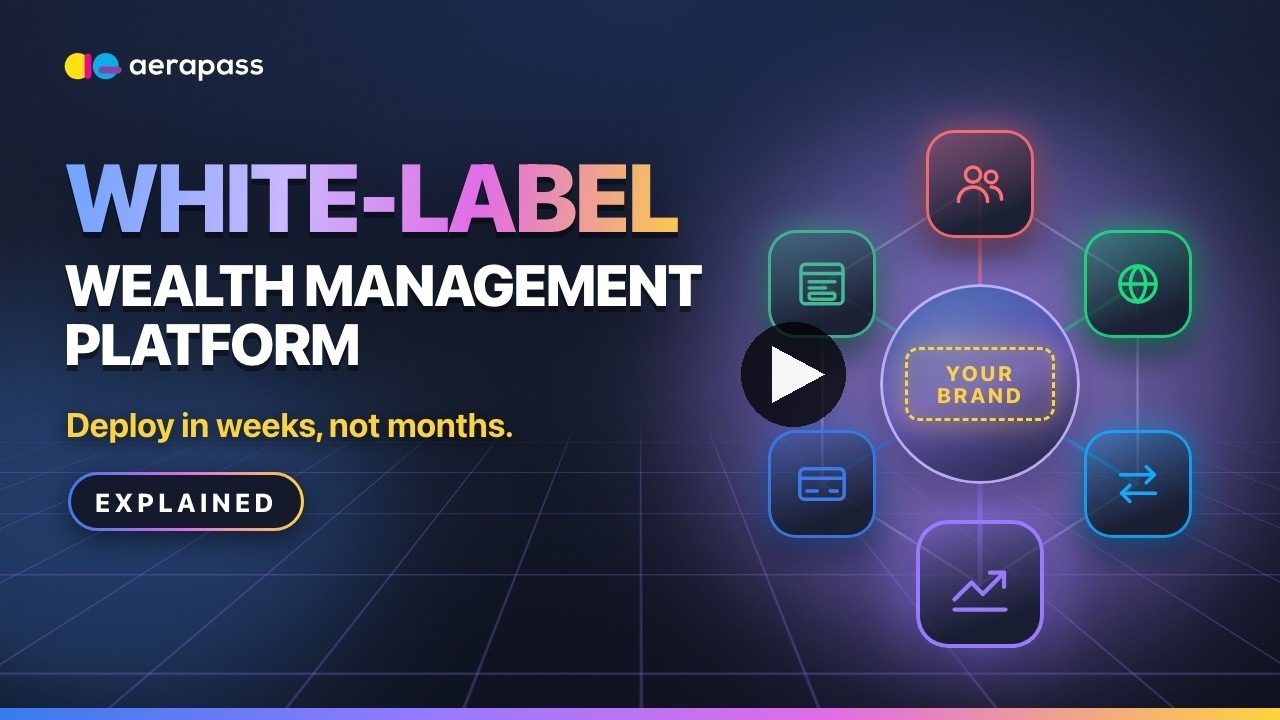
Watch the explainer: White-Label Wealth Management Platforms Explained
The content on this page is produced by Aerapass for general informational purposes only and does not constitute financial advice, investment advice, or any other form of professional advice. Aerapass is a technology platform provider serving financial institutions, wealth managers, and fintech companies. Before making any financial decision, you should consult with a qualified, licensed financial advisor who can take your individual objectives and circumstances into account.