E-Invoicing: How Aerapass Digitizes Billing
Key Takeaways
- The global e-invoicing market is projected to reach $15.5 billion by 2026, driven by government mandates.
- The EU’s ViDA framework mandates digital reporting for intra-EU B2B transactions from July 2030, with Belgium and Poland launching in 2026.
- India and Saudi Arabia already operate advanced e-invoicing clearance systems with real-time reporting requirements.
- Peppol is emerging as the global interoperability standard, adopted across Europe, Singapore, Malaysia, Australia, and New Zealand.
- Aerapass supports multi-currency, multi-payment-method e-invoicing with RESTful API integration.
What Is E-Invoicing?
E-invoicing is the automated exchange of invoice data between systems in a structured, machine-readable format - replacing PDFs and paper invoices with standardized digital documents that can be processed without manual intervention. Unlike a PDF invoice (which is essentially a digital image of a paper document), a true e-invoice carries structured data fields that accounting systems, tax authorities, and payment platforms can read, validate, and reconcile automatically. This distinction matters because governments worldwide now require structured e-invoicing to enable real-time tax reporting, reduce fraud, and close VAT gaps estimated in the hundreds of billions annually.
Electronic invoicing has moved from operational convenience to regulatory necessity. Governments worldwide are mandating e-invoicing to close tax gaps, reduce fraud, and modernise B2B commerce. For businesses operating across borders, compliance with multiple e-invoicing regimes is now a core infrastructure requirement - not an optional upgrade.
The Global E-Invoicing Mandate Wave
The shift to mandatory e-invoicing is accelerating across every major economic region, driven by government revenue protection and digital transformation agendas.
Global E-Invoicing Mandates Tracker
| Country/Region | Mandate | Deadline | Standard | Status | Source |
|---|---|---|---|---|---|
| EU (ViDA) | B2B digital reporting for intra-EU transactions | July 2030 | EN 16931 / Peppol | Adopted March 2025 | European Commission |
| Belgium | B2B e-invoicing (all businesses) | January 2026 | Peppol / UBL 2.1 | Confirmed | Belgian Federal Government |
| Poland (KSeF) | B2B e-invoicing via National Electronic Invoice System | February 2026 (large), April 2026 (all) | KSeF | Confirmed | Polish Ministry of Finance |
| France | B2B e-invoicing (phased rollout) | 2026-2027 | Factur-X / Peppol | Confirmed | DGFiP |
| Germany | B2B e-invoicing | 2027-2028 | EN 16931 | Confirmed | BMF |
| India | GST e-invoicing (expanding thresholds) | Ongoing (B2C pilots underway) | GSTN | Live since 2020 | GSTN |
| Saudi Arabia | ZATCA clearance model (all B2B/B2G) | Phased since 2023 | ZATCA | Live | ZATCA |
| Singapore | Peppol-aligned B2B | Voluntary (expanding) | Peppol | Active | IMDA |
Sources: European Commission ViDA package (March 2025), national government publications. Dates current as of March 2026.
The EU’s VAT in the Digital Age (ViDA) framework, adopted in March 2025, is the most consequential. It introduces mandatory structured e-invoicing and real-time digital reporting for intra-EU B2B transactions from July 2030, with member states implementing domestic mandates on earlier timelines. Belgium and Poland go live in early 2026. France and Germany follow in 2026-2028.
Outside Europe, India continues expanding its GST e-invoicing thresholds and is piloting B2C e-invoicing. Saudi Arabia’s ZATCA programme operates one of the most advanced real-time clearance systems globally, requiring businesses to submit invoices for government validation before they become legally valid.
Why E-Invoicing Mandates Matter for Cross-Border Businesses
For businesses operating across multiple jurisdictions, the compliance burden is compounding. Each country implements different standards (Peppol, UBL, CII, ZATCA, GSTN), different submission models (clearance vs post-audit), and different timelines. A fintech platform serving clients in Europe, Asia, and the Middle East must support multiple e-invoicing formats simultaneously.
The Peppol network is emerging as the closest thing to a global interoperability standard. Originally developed for EU public procurement, Peppol is now adopted by Singapore, Malaysia, Australia, and New Zealand for B2B invoicing. This convergence simplifies cross-border compliance for platforms built on Peppol-compatible infrastructure.
How Aerapass Addresses E-Invoicing
Aerapass provides electronic invoicing infrastructure designed for cross-border, multi-currency operations:
Multi-payment method support. Accept payments via credit cards (Visa, Mastercard, UnionPay) and cryptocurrency (USDT), enabling customers to settle invoices in their preferred method and currency.
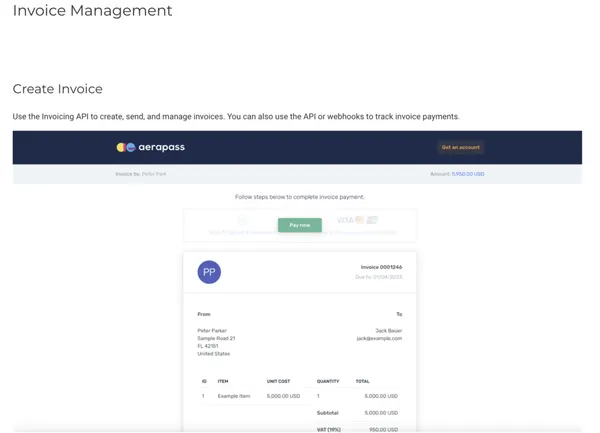
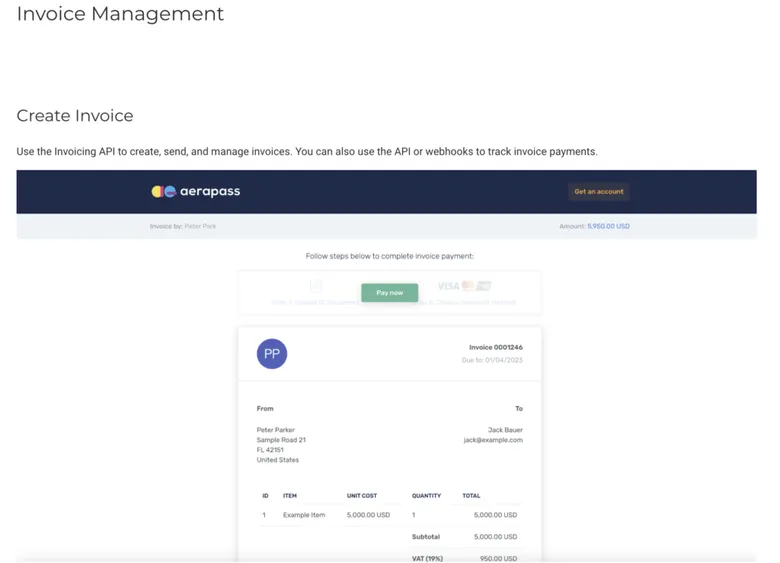
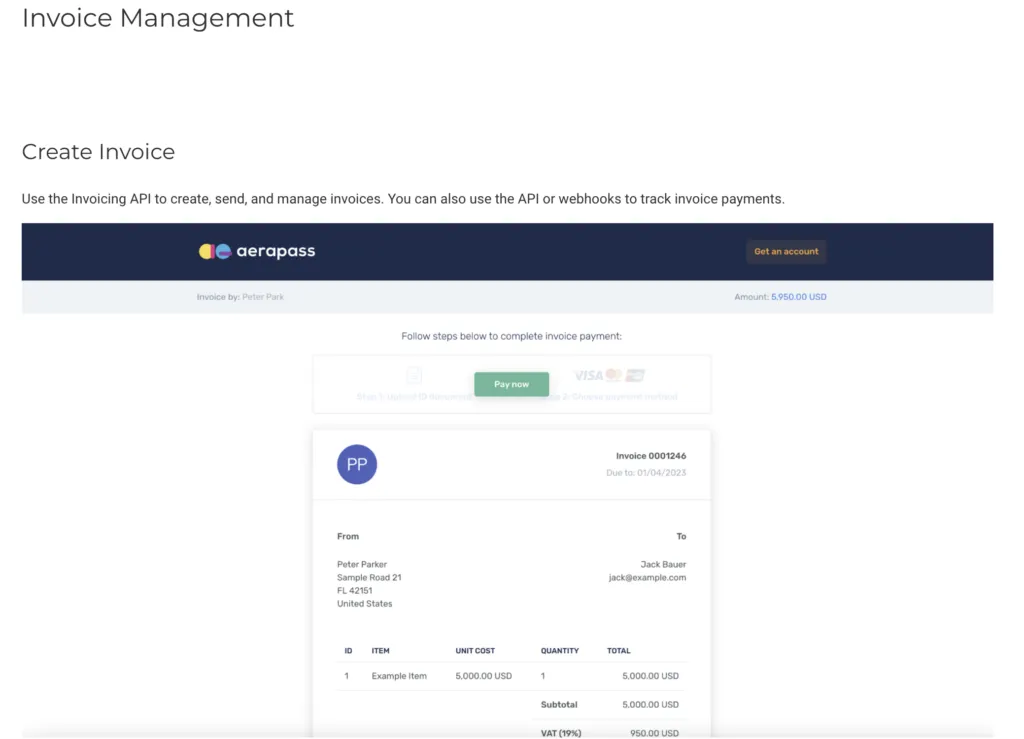
Automated billing workflows. Simplify invoice creation and distribution, automate payment reminders for due amounts, and reduce the administrative burden of managing receivables across multiple currencies and jurisdictions.
Secure payment processing. Offer secure payment options with clear, transparent billing information. Each transaction is auditable and traceable - a requirement under most e-invoicing clearance models.
RESTful API integration. Integrate Aerapass invoicing into existing ERP, accounting, or billing systems via API. This is critical for businesses that need to connect e-invoicing to their existing compliance workflows without replacing core systems.
Hosted payment pages. For businesses that need branded, white-label invoice payment experiences, Aerapass provides hosted payment pages that can be customised to match corporate branding while maintaining compliance with payment security standards.
Need multi-currency invoicing across jurisdictions? Aerapass supports e-invoicing with RESTful API integration, hosted payment pages, and multiple payment methods. Explore Aerapass global payments
The Road Ahead
The direction is clear: by 2030, most major economies will require structured electronic invoicing for B2B transactions. Businesses that build e-invoicing compliance into their payment infrastructure now will avoid costly retrofits later. Those operating across borders need platforms that can handle multiple standards, currencies, and regulatory regimes from a single integration point.
Summary
Governments across Europe, Asia, and the Middle East are making structured e-invoicing mandatory for B2B transactions, with the EU’s ViDA framework setting a July 2030 deadline for intra-EU digital reporting and countries like Belgium, Poland, and France implementing domestic mandates even sooner. Aerapass addresses this compliance challenge with multi-currency, multi-payment-method invoicing infrastructure, RESTful API integration, and hosted payment pages - enabling businesses to meet diverse e-invoicing requirements across jurisdictions from a single platform.
Frequently Asked Questions
Q: Which countries require mandatory e-invoicing in 2026?
Belgium requires B2B e-invoicing for all businesses from January 2026 using Peppol and UBL 2.1 standards. Poland launches its KSeF (National Electronic Invoice System) mandate in February 2026 for large businesses and April 2026 for all businesses. France begins its phased B2B e-invoicing rollout in 2026-2027 using Factur-X and Peppol standards. India continues expanding its GST e-invoicing thresholds with B2C pilots underway, and Saudi Arabia’s ZATCA clearance model has been live in phases since 2023.
Q: What is the EU ViDA e-invoicing framework?
The EU’s VAT in the Digital Age (ViDA) framework, adopted in March 2025, introduces mandatory structured e-invoicing and real-time digital reporting for intra-EU B2B transactions from July 2030. Member states are implementing domestic mandates on earlier timelines - Belgium and Poland go live in early 2026, with France and Germany following in 2026-2028.
Q: What is Peppol and how does it work for invoicing?
Peppol is an interoperability standard for electronic document exchange that is emerging as the closest thing to a global e-invoicing standard. Originally developed for EU public procurement, Peppol is now adopted by Singapore, Malaysia, Australia, and New Zealand for B2B invoicing. Belgium’s 2026 mandate uses Peppol and UBL 2.1, and the convergence around Peppol simplifies cross-border compliance for platforms built on Peppol-compatible infrastructure.
Q: What are the differences between e-invoicing standards like UBL, CII, and Peppol?
Different countries implement different e-invoicing standards. Belgium uses Peppol and UBL 2.1, France uses Factur-X (based on CII), the EU ViDA framework references EN 16931, and Saudi Arabia uses its own ZATCA standard. India operates GSTN, while Poland has developed the KSeF system. For businesses operating across multiple jurisdictions, this means a fintech platform must support multiple e-invoicing formats simultaneously.
Q: What are Saudi Arabia’s ZATCA e-invoicing requirements?
Saudi Arabia’s ZATCA program operates one of the most advanced real-time clearance systems globally. It requires businesses to submit invoices for government validation before they become legally valid. The ZATCA clearance model covers all B2B and B2G transactions and has been rolling out in phases since 2023.
Ready to future-proof your invoicing? Aerapass provides hosted payment pages and multi-payment-method support for businesses navigating global e-invoicing mandates. Start with Aerapass hosted payment pages
References
- European Commission - VAT in the Digital Age (ViDA) package, adopted March 2025
- Belgian Federal Government - B2B e-invoicing mandate, January 2026
- Polish Ministry of Finance - KSeF (National Electronic Invoice System), February/April 2026
- DGFiP (Direction generale des Finances publiques, France) - B2B e-invoicing phased rollout, 2026-2027
- BMF (Bundesministerium der Finanzen, Germany) - B2B e-invoicing, 2027-2028
- GSTN (Goods and Services Tax Network, India) - GST e-invoicing, live since 2020
- ZATCA (Zakat, Tax and Customs Authority, Saudi Arabia) - Clearance model, phased since 2023
- IMDA (Infocomm Media Development Authority, Singapore) - Peppol-aligned B2B invoicing
The content on this page is produced by Aerapass for general informational purposes only and does not constitute financial advice, investment advice, or any other form of professional advice. Aerapass is a technology platform provider serving financial institutions, wealth managers, and fintech companies. Before making any financial decision, you should consult with a qualified, licensed financial advisor who can take your individual objectives and circumstances into account.